7 High RTP Pokies Categories Aussie Players Prefer
High RTP pokies get attention because they suggest a better long-run return than the average slot. The smart way to read that claim is simple: RTP helps you compare game maths, but it does not tell you what will happen in your next session.
TL;DR: Summary
- High RTP pokies are slot games with a higher theoretical target RTP, but RTP is a long-run average, not a session-by-session guarantee; volatility still shapes whether play feels smooth or brutal.
- The most practical high RTP pokies categories are classic reels, free-spins video slots, expanding-wild games, cascading reels, Megaways-style titles, low-volatility retro slots, and fixed-jackpot games instead of large progressives.
- Check the help file or paytable, confirm the exact game variant because RTP settings can differ by operator, and compare RTP with volatility before staking.
- For Australians, ACMA classifies online casinos and online slot machines as prohibited interactive gambling services under the Interactive Gambling Act 2001, so legal status and safer gambling limits matter as much as RTP.
For Australian readers, that compliance point matters. ACMA says online casinos and online slot machines are prohibited interactive gambling services for customers in Australia, so any RTP discussion should be read as game-maths education first, not as a shortcut to outcomes.
What does high RTP mean in pokies?
High RTP pokies return a larger share of total stakes over time; the Gambling Commission describes percentage RTP as money returned as prizes over a significant number of plays. That makes RTP a comparison tool, not a prediction tool.
A pokie's RTP is theoretical. Regulators also use the phrase theoretical target RTP to separate designed long-run return from what a player sees in one sitting. If a game shows 96% RTP, that does not mean $96 comes back from your next $100. It means that, over a very large sample of spins across all players, the game is designed to return about 96% of stakes.
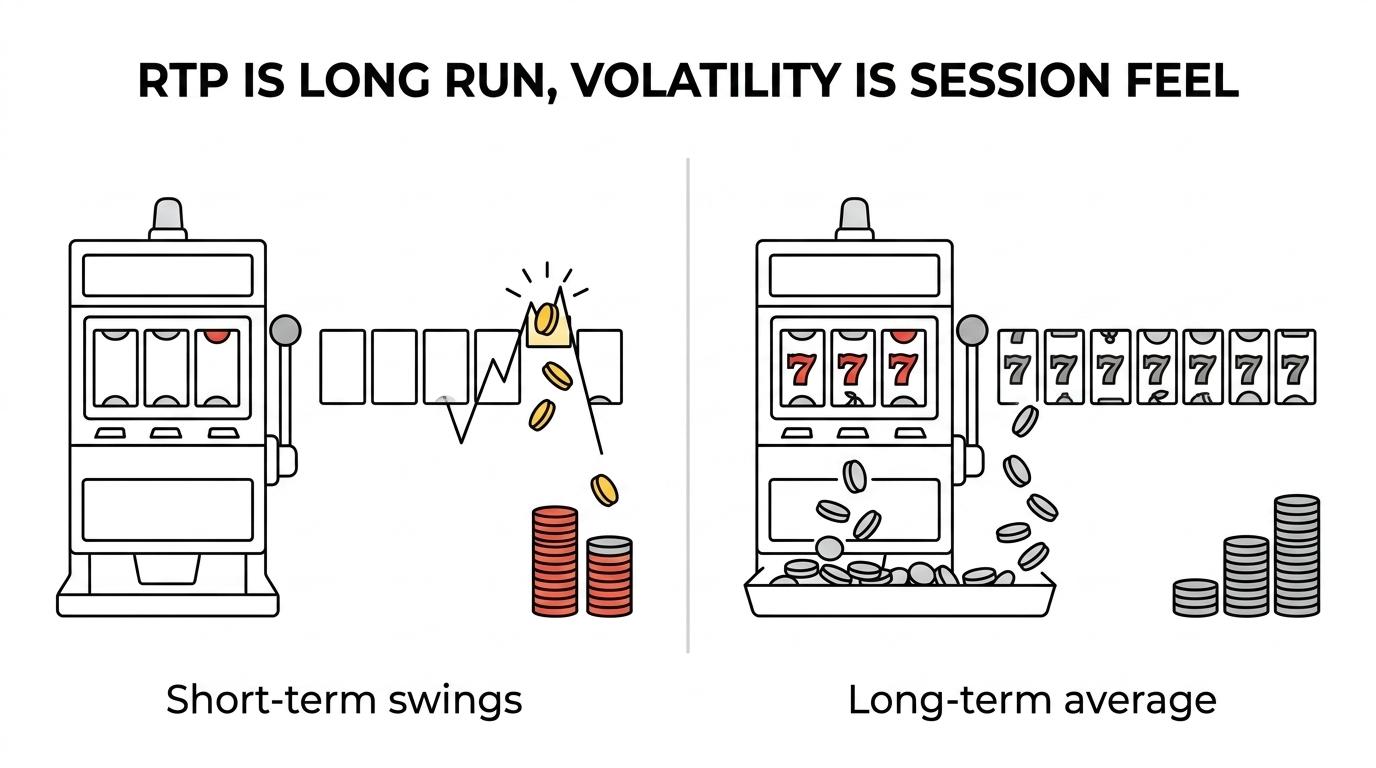 Side-by-side comparison of RTP as a long-run average versus volatility as the size and frequency of session swings.
A common misconception is that "high RTP" automatically means "safer" or "better". It can mean better value on paper, but only when you compare like with like. The manufacturer decides the RTP setting, and regulators note there is no universal minimum RTP requirement on gaming machines. If two versions of the same title exist, the higher published RTP version is usually the better mathematical choice, yet session experience can still vary sharply.
Why do Aussie players care about RTP more than hit frequency?
RTP matters more than hit frequency when the goal is long-run value; hit frequency only tells you how often wins appear, not whether those wins are large enough to offset losses. Net return and game feel are different things.
A game can trigger lots of tiny line wins and still have a weaker overall payout profile than a quieter title with a stronger RTP. That is why experienced players compare at least three items together: published RTP, volatility, and feature structure. Hit frequency helps explain rhythm. RTP helps explain theoretical value.
Bankroll planning becomes easier when the cashier and stake sizes are in one currency. That matters because RTP comparisons lose value when fees, conversion, or oversized minimum deposits distort the real session cost.
"Fortune88 accepts AUD only and lists a minimum deposit of AUD 10, which makes low-stake bankroll planning clearer for Australian players."
The useful mindset is this: if a game wins often but barely moves your balance, high hit frequency may be masking weak value. If a game wins less often but the RTP is stronger and volatility suits your bankroll, it may be the better fit.
What are the 7 high RTP pokies categories Aussie players prefer?
The most searched high RTP pokies categories tend to share one trait: they offer stronger published RTP without relying on giant progressive jackpots. Categories do not guarantee outcomes, but they do help narrow the field.
When Australian readers look for better-return slot types, they usually gravitate to categories where the math is easier to compare and the feature design is visible in the paytable.
- Classic three-reel high RTP pokies Simpler reel setups often make the return profile easier to read. These titles can suit players who want lower feature clutter and steadier bankroll pacing.
- Free-spins video pokies Much of the value often sits inside the bonus round. If free spins arrive at a reasonable rate and multipliers are not overly top-heavy, these games can feel efficient.
- Expanding-wild pokies Expanding or stacked wilds improve reel coverage and can lift medium-size win potential without needing a jackpot mechanic.
- Cascading reels pokies Wins that clear and re-evaluate the grid can create extra value from one paid spin. The trade-off is that volatility can creep up fast.
- Megaways-style pokies Variable reel ways and layered features attract players who want higher ceiling potential. The catch is that a good RTP number can still come with a wild ride.
- Low-volatility retro or fruit pokies These are popular with players who care more about session length than huge peak wins. A slightly lower ceiling can make the bankroll last longer.
- Fixed-jackpot or jackpot-lite pokies If the goal is RTP, fixed-prize games often beat large progressives. A common mistake is assuming the biggest advertised jackpot means the best mathematical value.
How can you check a pokie’s RTP in three steps?
The best way to check RTP is to verify the number inside the game, confirm the exact version, and read it beside volatility. A paytable alone is not enough.
Step 1. Open the game's help, information, or paytable panel and look for the published RTP or percentage RTP. Many titles place it in the rules section, not on the main lobby card.
Step 2. Confirm the exact variant. This matters because some providers or operators run the same title at different RTP settings. If the listed RTP is absent, hidden, or vague, that is a useful signal by itself.
Step 3. Read the RTP beside volatility, bonus structure, and top-win profile. Pro tip: a 96% slot with very high volatility can feel harsher in a short session than a slightly lower-RTP game with calmer distribution.
Regulators note that RTP will vary over a typical session because of normal game volatility. So the question is not "Is this RTP real?" but "Is this RTP published clearly, and does the volatility match my budget?"
How is RTP different from volatility in pokies?
RTP measures the long-run share of stakes returned as prizes; volatility measures how unevenly that return is delivered. The Gambling Commission and gaming-machine guidance make that distinction clear.
Think of RTP as the average and volatility as the route taken to reach that average. Two games can both publish 96% RTP, yet one may produce frequent small wins while the other spends long periods cold before landing an occasional larger hit.
If your bankroll is small or your session is short, volatility often matters more than a tiny RTP edge. If your bankroll is larger and you can tolerate longer dry spells, a high-volatility title may still suit you. That is why "higher RTP" and "better experience" are not interchangeable phrases.
A useful rule is this: if a game's bonus round carries most of the return, expect wider swings. If value is spread across base-game hits, the session will usually feel steadier.
Which matters more for high RTP pokies: base-game features or jackpot mechanics?
Base-game features usually matter more than jackpot mechanics when the priority is stable value. Fixed features and repeatable bonuses are easier to evaluate than prize pools built around rare headline hits.
Large progressives are exciting because of the top prize, yet they often change how value is distributed. Part of the appeal sits in a very rare outcome, which can make everyday play feel thinner. That does not always mean lower RTP, but it often means harsher short-run experience.
By contrast, wild multipliers, expanding symbols, respins, and achievable free-spin features spread value across more ordinary sessions. If the aim is balance, these mechanics are usually easier to live with. If the aim is a once-in-years ceiling, jackpot games are the obvious fit.
A common mistake is treating all jackpots as the same. Fixed jackpots, daily drops, and large shared progressives can behave very differently even when the lobby groups them together.
How should you shortlist high RTP pokies in three steps?
A strong shortlist starts with a hard RTP floor, then filters by volatility, then checks real session practicality. Published numbers matter most when they connect to how you actually play.
Step 1. Set a minimum standard and ignore games that do not publish RTP clearly. Many players use the mid-90% range as a first screen, then compare only titles above that internal cut-off.
Step 2. Split candidates by volatility and feature type. Put free-spins games in one group, classic reels in another, and jackpot games in a third. This avoids comparing titles that solve different player needs.
Operational details matter as much as maths. A quick, bank-native funding method helps keep a planned session separate from impulse top-ups or awkward currency conversions.
"Fortune88 says OSKO deposits are compatible with all major Australian banks and are credited within 1 minute."
Step 3. Trial the final shortlist at the lowest available stake and track pace, bonus frequency, and bankroll burn. Pro tip: you are not testing whether a game is "due". You are testing whether its volatility fits your session length.
What mistakes do players make when chasing high RTP pokies?
Most RTP mistakes come from reading a long-run statistic as a short-run promise. The result is usually poor game selection, not bad luck alone.
The first trap is chasing a number without checking the variant. The second is ignoring volatility because the RTP looks attractive. The third is assuming a busy feature set automatically means better value. Many modern slots add excitement without improving the underlying maths.
A cleaner way to think about mistakes is to separate game maths from session psychology:
- Confusing RTP with outcomes: a theoretical target RTP says nothing reliable about the next 20, 50, or 200 spins.
- Ignoring operator settings: the same title can run at different RTP configurations.
- Overlooking volatility: a high RTP figure can still come with deep drawdowns.
- Trusting jackpot headlines: a huge top prize does not prove stronger overall value.
One more misconception is worth flagging. Bonus size and promotion are different decisions. A promotion may improve starting value, but it does not rewrite the game's core payout model.
How can you set a bankroll and session plan for high RTP pokies in three steps?
A bankroll plan should control session length, stake size, and stopping rules before the first spin. RTP works best as a filter when the spending plan is already fixed.
Step 1. Set a cash cap and a time cap. If the amount would affect bills, savings, or essentials, it is not a session bankroll. That decision comes before game choice.
Step 2. Choose a stake that leaves room for normal variance. If 20 or 30 routine losing spins would wipe out the plan, the stake is too high for that bankroll. This is where lower-volatility, high RTP categories often make more sense.
Low entry points are useful when you are testing whether a supposedly high RTP game also matches your preferred volatility and session length.
"Fortune88 lists a minimum deposit of AUD 10, a practical entry point for low-stake testing in AUD."
Step 3. Pre-set a stop-loss, a stop-win, and a break point. If you hit any of them, stop. Pro tip: players often plan a stop-loss and forget the stop-win, which can turn a disciplined session into a long, noisy chase.
What legal and responsible gambling facts should Australians know before reading RTP tables?
Australians should know that ACMA classifies online casinos and online slot machines as prohibited interactive gambling services for customers in Australia. Legal status is not a side note to RTP. It is central.
Under the Interactive Gambling Act 2001, ACMA can ask internet service providers to block websites that breach the law. That means a mathematically attractive game is still the wrong choice if the service itself is prohibited.
Responsible gambling signals are also strong in official data. In the adjacent market of licensed online and phone wagering providers, ACMA reported 59,830 people had registered to self-exclude by 31 March 2026, with 37,247 active exclusions at that date. The formats differ, but the message is clear: many Australians actively use hard limits when gambling starts to feel unhealthy.
Three facts should stay front of mind:
- Legal status: ACMA says online casinos and online slot machines are prohibited interactive gambling services for Australian customers.
- Enforcement: ACMA can seek ISP blocking for sites that breach the Interactive Gambling Act 2001.
- Risk control: self-exclusion tools exist because chasing losses and overestimating short-run returns are common behavioural risks.
If RTP is the lens, keep it in focus. Treat high RTP pokies as a way to compare published game maths, pair that number with volatility, and let legal and responsible gambling limits overrule every other factor.