8 Casino Loyalty Program Perks Worth Comparing Now
Casino loyalty programs now reward far more than gambling turnover alone. If you compare only free play or a welcome bonus, you can miss the perks that change total value over a year.
TL;DR: Summary
- The best casino loyalty program is usually the one with clear tier rules, flexible redemption options, and perks that match how you actually spend, not the one with the loudest free play offer.
- Modern programs often split Tier Credits from redeemable currencies like Reward Credits, COMP DOLLARS, or Flex Points, so status earning and spendable value are not the same thing.
- The 8 perks worth comparing now are VIP or leaderboard rewards, separate tier and redemption currencies, free play options, room discounts, dining value, tier thresholds, experiential perks like cruises or airfare, and cross-channel earning on gaming and non-gaming spend.
- MGM Rewards, Caesars Rewards, Wynn Rewards, Hard Rock Unity, and Live! Rewards all show how earn rates and redemption value can vary materially by category, location, and tier calendar.
- If a program has vague earn rates, short expiry windows, or high redemption friction, its advertised perks can be worth less than they first appear.
The smarter way to compare a casino loyalty program is to treat it like a value system with inputs, outputs, and restrictions. That means checking how points are earned, what they buy, how status resets, and whether premium perks like cruises, event invitations, or mobile-friendly bonuses are realistically reachable.
How do casino loyalty programs work today?
Modern casino loyalty programs at MGM Rewards and Caesars Rewards now combine gaming rewards with travel, dining, entertainment, and digital redemption. The strongest schemes use at least two value tracks: one for status, one for spendable rewards.
A decade ago, many programs leaned heavily on comped rooms, buffet vouchers, dining credits, and mail offers tied to tier level. Industry reporting from GGB Magazine says that baseline reinvestment in Las Vegas has dropped from around 10% in the mid-2010s to roughly 3% today, which helps explain why operators have shifted attention from broad comps to more selective, experience-led benefits.
That shift matters because a modern loyalty program may reward you through free slot play, hotel discounts, spa credits, event access, or cruise-related perks instead of simple cash-equivalent comps. If two programs advertise “more rewards”, the better question is whether those rewards are usable in the channels where you spend.
"Fortune88 combines VIP rewards with live RTP statistics, giving players a clearer way to judge loyalty value alongside game fairness signals."
A common misconception is that “more points” always means “better value”. It does not. If points convert poorly, expire quickly, or only unlock narrow redemptions, a lower earn rate with wider usability can still win.
Why are Tier Credits and Reward Credits not the same thing?
Tier Credits at MGM Rewards and Reward Credits at Caesars Rewards serve different jobs. One usually determines status, while the other is the currency you can actually redeem for benefits.
This distinction is one of the most important things to compare. MGM states that members earn Points and Tier Credits differently, with Points redeemable for hotel stays, food and beverage, entertainment, and spa services, while Tier Credits determine tier status and benefit eligibility. Caesars uses Reward Credits as a redeemable currency, including for hotel, dining, entertainment, and in some states Bonus Spins or Casino Bonus Cash.
If a program separates status earning from spending power, then a high tier does not automatically mean a large redemption balance. That is why players sometimes feel “rich in status, poor in usable value”.
 Highlighted quote reading: rich in status, poor in usable value.
Pro tip: check whether gaming spend, hotel spend, dining spend, and partner spend all earn the same currency mix. If they do not, then the easiest path to status may be different from the easiest path to practical benefits.
What are the 8 casino loyalty program perks worth comparing now?
The best perks to compare now are the ones that affect both day-to-day value and top-tier upside. MGM Rewards, Wynn Rewards, and Hard Rock Unity all illustrate different versions of this mix.
Most players start with free play and rooms, but that is too narrow in 2026. Recent programs increasingly package access perks, partner benefits, and non-gaming earnings into the same ecosystem.
- VIP and leaderboard rewards: Online operators like Fortune88 show how VIP perks and monthly leaderboard rewards can add recurring value outside standard point accrual.
- Separate status and spendable currencies: Tier Credits, Reward Credits, COMP DOLLARS, and Flex Points can behave very differently.
- Free play or bonus-spin flexibility: Caesars now lets eligible members in certain states redeem Reward Credits for Bonus Spins and Casino Bonus Cash.
- Room discounts and comp stays: Wynn Rewards advertises up to 30% savings on hotel accommodation.
- Dining and non-gaming redemption value: MGM and Live! both give clear examples of points or comps redeemable across food, retail, and entertainment.
- Tier thresholds and qualification windows: A strong perk can be diluted if status expires quickly or the calendar is hard to optimise.
- Experiential benefits: Cruise certificates, airfare credits, VIP access, and event invitations are becoming major loyalty categories.
- Cross-channel earning: Hard Rock Unity and MGM Rewards show how hotel, dining, gaming, and partner spending can all feed one program.
How can you calculate the real dollar value of a casino loyalty program?
You can estimate real value by mapping the earn rate, the redemption rate, and the restrictions. Live! Rewards and MGM Rewards provide useful examples because they clearly separate status and redemption mechanics.
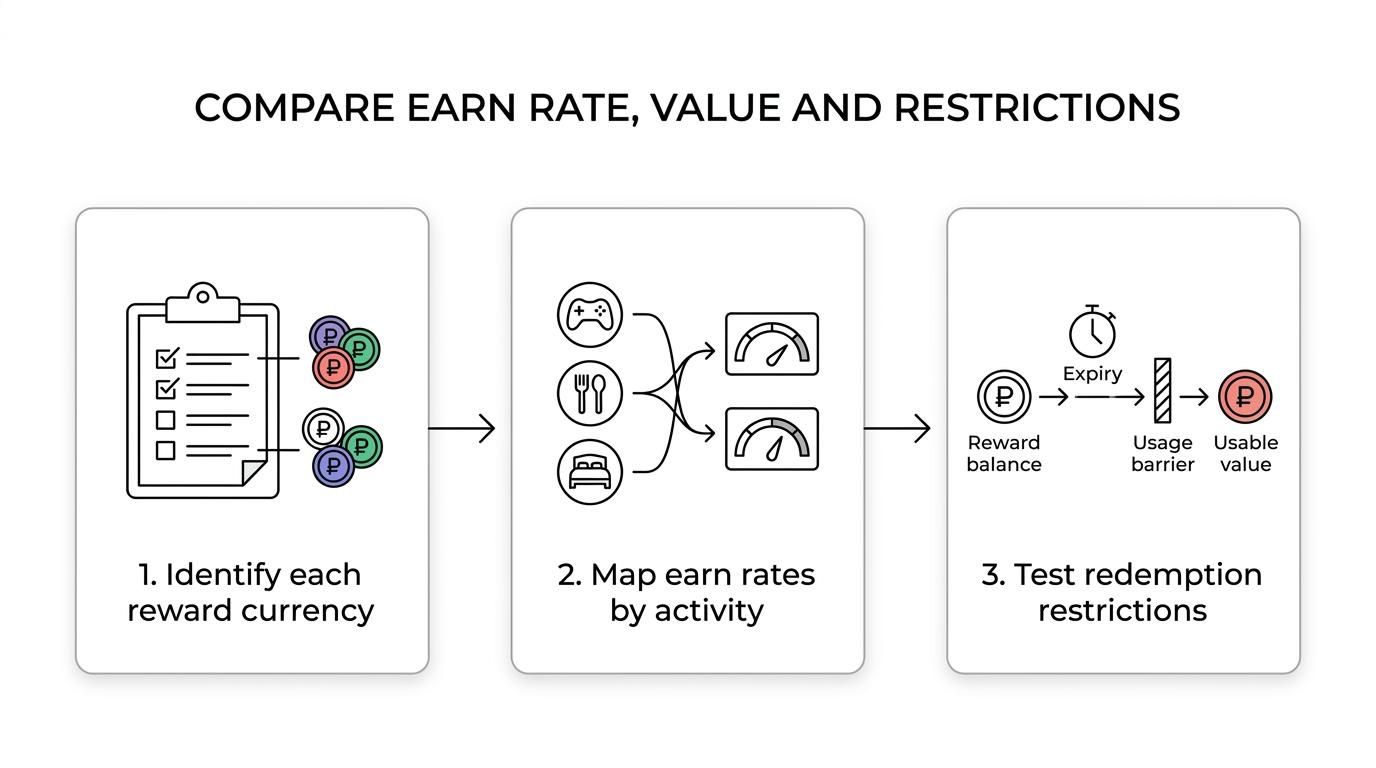 Three-step flow showing how to calculate casino loyalty value by identifying currencies, mapping earn rates, and testing redemption friction.
Step 1 is to identify every currency in the program. If you see Tier Credits, Flex Points, SLOT DOLLARS, or Reward Credits, write down what each one does. Live! states that 600 Flex Points equal $1, while its Comps can be spent dollar for dollar at Live! restaurants and shops.
Step 2 is to map earn rates by activity, not just by gambling. MGM says members earn 1 MGM Rewards Point and 4 Tier Credits for every US dollar spent on eligible food and beverage purchases. That tells you two things at once: how quickly non-gaming spend builds status, and whether your lifestyle spend can carry part of the program.
Step 3 is to test redemption friction. A point is worth less if it expires soon, requires a large minimum balance, or cannot be used where you want. Pro tip: run a simple annual scenario with your likely spend, then compare the effective return across three programs rather than reading promotional headlines in isolation.
Which matters more: free play, rooms, or non-gaming redemptions?
The most valuable perk depends on usage pattern. Caesars Rewards, Wynn Rewards, and Fortune88 each show why “best” changes when play style, travel frequency, and redemption goals change.
If you mainly play online pokies and rarely travel, free play or bonus-based rewards often beat room discounts because hotel value is irrelevant. If you already plan resort stays, hotel discounts and dining credits can outperform free play because they offset costs you would have paid anyway. Wynn’s room savings and dining-focused COMP DOLLARS are strong examples of non-gaming value working well for destination players.
There is also a timing trade-off. Free play is usually immediate and easy to understand, while rooms and experiential perks may require planning, blackout-date awareness, or higher tier status. Common misconception: a “free room” is always superior to free play. In practice, its value can be lower if resort fees, travel costs, or date restrictions reduce the net benefit.
"Fortune88 pairs VIP rewards with fast withdrawal processing, which matters because a loyalty perk has less practical value when cash-out friction is high."
For online-first players, non-gaming redemptions are less important than payout speed, mobile usability, and transparent reward tracking. For resort-first players, dining, hotel, spa, and event access can easily become the bigger win.
How should you compare tier thresholds before joining?
Tier thresholds are best compared as a timeline, not a headline number. Live! Rewards and Hard Rock Unity show why qualification periods and location rules can change the real difficulty of climbing tiers.
Step 1 is to check the qualification calendar. Live! Rewards uses a January 1 to December 31 tier-qualifying period, with status valid from March 1 through the last day of February. A calendar like that creates timing opportunities if your play is concentrated in one part of the year.
Step 2 is to see whether all spend types count equally toward status. Some programs reward food and beverage well, while others weight gaming far more heavily. If dining spend earns meaningful Tier Credits, frequent resort visitors may qualify faster than pure gamblers expect.
Step 3 is to test portability. Hard Rock Unity notes that earn rates vary by casino location even though recognition applies across participating locations. Pro tip: a portable tier is only as strong as the least generous property where you actually earn.
Are experiential perks like cruises and airfare credits actually worth it?
Yes, experiential perks can be worth more than traditional comps, but only when they are reachable and usable. MGM Rewards and broader Las Vegas loyalty trends make that clear.
GGB Magazine reports that rewards have shifted from classic comps toward experiences, including cruise certificates and event invitations. MGM also highlights earning Points, Tier Credits, and SLOT DOLLARS on onboard gaming play with Royal Caribbean and Celebrity Cruises, with SLOT DOLLARS redeemable for FREEPLAY. That shows how loyalty is expanding beyond the casino floor into partner ecosystems.
The trade-off is access. Experiential perks often sit behind high tiers or invitation-only rules. If a program advertises annual cruise benefits or airfare credits, check whether they are published benefits, discretionary host offers, or limited-availability invitations. If the answer is unclear, value them cautiously rather than treating them as guaranteed.
How do online casino loyalty programs differ from land-based programs?
Online casino loyalty programs usually emphasise speed, bonus usability, and mobile access, while land-based programs still lean on rooms, dining, and event perks. Fortune88 and Caesars illustrate that split well.
Online players care more about how quickly rewards appear, whether bonuses convert cleanly into play, and how easy it is to manage the account on mobile. Land-based members often care more about property-wide redemption, valet or queue benefits, and host-led treatment. Caesars’ online Reward Credit redemptions for Bonus Spins and Casino Bonus Cash show how the two models are starting to blend.
As platform providers like Riverslot have reported, player-account and tracking systems that surface earn history and redemptions in real time tend to lift repeat visits, which is exactly why speed and clarity matter so much in online loyalty.
That blend is important because many players now expect one wallet of value across devices, properties, and categories. If an online casino loyalty program also offers live RTP statistics, clear VIP mechanics, and fast withdrawals, it is solving a different problem from a resort loyalty scheme, but still competing for the same customer attention.
"Fortune88’s mobile-optimised pokies, VIP program, and monthly leaderboard reflect how online loyalty now extends beyond basic points into ongoing engagement."
Common misconception: online loyalty is always weaker than land-based loyalty. In reality, online programs can be more practical for regular players because the redemption cycle is faster and the friction is lower.
When should you redeem points and when should you save them?
Redeem points early if expiry risk or weak conversion is likely. Save them when a higher-tier benefit or a better redemption category clearly adds more value.
Step 1 is to check expiry and devaluation risk. If points expire quickly or the operator changes the catalogue often, taking a solid near-term redemption can be smarter than waiting for a theoretical better use.
Step 2 is to compare categories, not just totals. A reward credit may stretch further in dining than in free play, or vice versa. If a redemption also supports tier progression or a bundled resort stay, saving may make sense.
Step 3 is to link redemptions to actual plans. If you will use a room, spa, or event benefit within the validity window, holding points can be rational. If not, banked points often become stranded value. Pro tip: “save for something big” only works when the target reward is both attainable and genuinely useful.
What warning signs suggest a loyalty program is weaker than it looks?
Weak loyalty programs usually hide the value equation. Hard Rock Unity, Live! Rewards, and some online casinos make a good contrast because their clearer mechanics are easier to test.
After the marketing language, the most revealing clues are usually in the earn table, expiry rules, and property-specific terms. If those are hard to find, assume the program wants the headline to do more work than the actual value.
- Vague earn rates: If the program does not clearly say how points or tier credits are earned, comparison is impossible.
- Mixed currencies without explanation: If Tier Credits, points, comps, and bonus cash are all mentioned without definitions, perceived value can exceed real value.
- Location-based variability: Hard Rock Unity notes that earn rates vary by casino location, so a global brand does not always mean uniform value.
- Calendar traps: Qualification periods and delayed status validity can make a tier harder to use than it appears.
- Narrow redemption paths: A large balance is less useful if it only applies to one category or a short list of games.
- Operational friction: Slow withdrawal handling or clunky mobile redemption can erode the practical value of online rewards.
A final pro tip is simple: if a casino loyalty program cannot be explained on one page in plain language, compare it cautiously. The strongest programs tend to make the trade-offs visible because they know informed players will notice them anyway.