How RTP Shapes Online Pokies Choices for New Players
Choosing online pokies for the first time can feel simple at a glance. Bright themes, bonus rounds and jackpots tend to grab attention first. Yet one number often has more influence on the quality of a choice than any animation or feature list: RTP.
For new players, RTP can be genuinely useful. It gives a quick way to compare games and spot differences that are not obvious from appearance alone. Still, it is also one of the most misunderstood figures in online gambling, especially when it is read as a promise about what will happen in the next ten minutes.
That gap between what RTP means and what players think it means matters. A clearer view of RTP can lead to calmer decisions, better comparisons and a more realistic sense of how pokies work.
What RTP means in online pokies
RTP stands for return to player. In simple terms, it is the percentage of all money wagered on a pokie that is expected to be paid back over a very large number of spins.
If a game has 96% RTP, that does not mean a player who stakes $100 will get $96 back in a session. It means that, across a huge sample of play, the game is designed to return $96 for every $100 wagered, with the remaining $4 representing the house edge.
That long-run framing is the key point.
 A quote highlight featuring the line: RTP is a comparison tool, not a guarantee.
Australian responsible gambling material makes this very clear. RTP is useful as a broad measure of a game’s theoretical return, but it is highly unlikely to describe what happens during one player’s short session. A few spins can go very well. A few hundred spins can still fall well above or below the advertised figure.
A quick comparison helps:
Term | What it means | What it does not mean |
|---|---|---|
RTP | Expected percentage returned over a very long period of play | A forecast for your next session |
House edge | Expected percentage kept by the game over the long run | Proof that every short session will lose that amount |
Volatility | How wins tend to be distributed, from steadier small returns to rarer larger ones | A measure of RTP itself |
Session result | What happens to one player over one period of play | Evidence that the RTP figure is wrong |
This is why RTP is best treated as a comparison tool, not a guarantee.
Why RTP percentages are often misunderstood
The number looks friendly. That is part of the problem.
A 90% RTP message can sound as if the game is likely to hand back 90 cents of every dollar to each player, almost as a personal expectation. Research suggests many people read it that way, even though that is not what the statistic means.
A large 2025 study published via PubMed tested more than 6,000 slot players across two countries. Participants were shown different messages before rating their chances of winning on a new machine. The researchers reported that gamblers consistently misunderstand RTP information, and earlier work had already found that a 93% RTP message could make people feel more likely to win than receiving no information at all.
That is striking. A disclosure meant to improve knowledge can, in some cases, create more confidence than silence.
Australian research points in the same direction. In a sample of 603 adults, people understood a house-edge message more accurately than a standard RTP message. The figures were strong: 79.9% correctly understood the house-edge wording, compared with 52.9% for RTP wording alone. When a volatility warning was added to the RTP message, understanding improved to 63.5%, yet house-edge wording still performed best.
The meaning was exactly the same. A 10% house edge is equivalent to a 90% RTP. Yet the wording changed how people judged their chances.
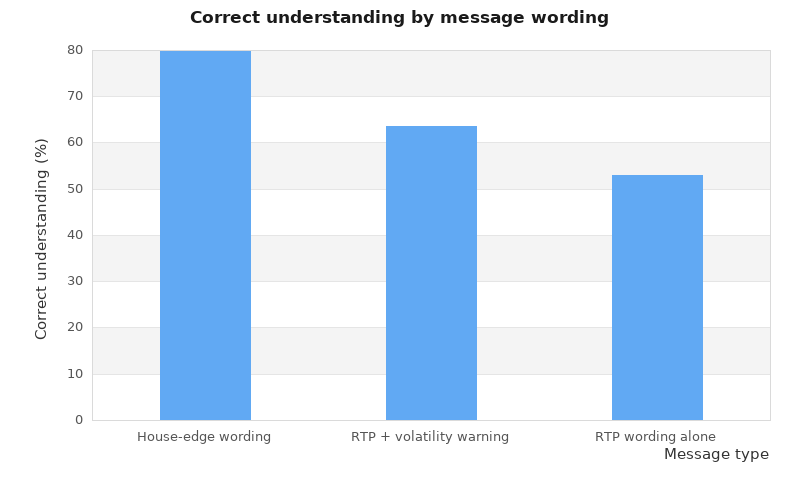 A three-column chart comparing correct understanding of gambling messages: house edge 79.9%, RTP plus volatility warning 63.5%, and RTP alone 52.9%.
That matters because new players often make quick decisions. If one format makes a game feel more generous than it really is, perception can drift away from reality.
House edge wording versus RTP wording for new players
Many people find house-edge wording less inviting but easier to interpret. Saying a game has a 10% house edge tends to sound more direct than saying it has 90% RTP, even though they express the same maths.
This does not mean RTP is useless. It means the number benefits from context.
When RTP is presented on its own, new players may assume it applies to their next session. When the same information is paired with a note that it reflects a long-run average over millions of spins, the message becomes far more grounded. That extra sentence can change the way the statistic is read.
A practical way to think about it is this:
- RTP wording: often sounds positive and can feel like a likely return
- House-edge wording: often sounds more cautious and is easier to interpret correctly
- Volatility warning: reminds players that short sessions can look very different from the long-run average
For beginners, the smartest move is to mentally translate RTP into both forms. A 96% RTP game is also a 4% house-edge game. Seeing both sides of the same figure can reduce the chance of reading it too optimistically.
How RTP helps compare online pokies choices
Used properly, RTP is still one of the best filters available when scanning a lobby full of pokies.
If two games are equally appealing and one has 96.5% RTP while the other has 94%, the higher RTP game is generally giving more back over the long run. That does not settle every decision, though it gives a meaningful point of difference.
The value of RTP grows when it is paired with a few other checks. Theme and bonus features matter for entertainment, but they should not be the only lens.
After a quick look at the game details, it helps to compare:
- RTP percentage
- volatility level
- minimum and maximum stake
- feature frequency
- bonus round structure
- mobile readability and spin controls
A new player who looks at only one number may miss the full picture. A player who ignores RTP completely may miss a very useful signal.
RTP pokies and volatility work together
Volatility is the piece many beginners overlook.
Two pokies can share the same RTP and still feel completely different to play. One might deliver smaller wins more often. Another might hold back for long stretches and then pay larger amounts less often. Both can arrive at the same theoretical return over time, but the player experience is not the same at all.
That is why a volatility warning improves comprehension. It reminds players that the path to the RTP figure is uneven.
Low volatility games can suit players who want longer sessions and steadier feedback. High volatility games can appeal to players who enjoy chasing bigger hits, while accepting that dry spells may be longer and sharper. Neither style changes the basic lesson: short-term results can swing hard in either direction.
This is especially relevant for bankroll planning. A high RTP game with very high volatility can still feel brutal during a short session. A slightly lower RTP game with gentler variance may feel more stable, even if its long-run return is not as strong.
Reading RTP information on Australia-focused casino sites
Not every game page presents RTP in the same way. Some show it clearly in the information panel. Others hide it in help files or technical notes. For new players, easy access to RTP data is more than a convenience. It supports better choices before any money is staked.
Australia-focused sites that publish clear game stats can make the process much smoother, especially on mobile where screen space is limited and players often skim. A visible RTP field, alongside volatility or game rules, helps turn a vague feeling into a more informed pick.
When checking a game, look for a few signs of transparency:
- Visible RTP figure: displayed before play starts, not buried deep in rules
- Volatility information: a label or guide showing whether swings are mild or sharp
- Paytable access: quick access to symbols, feature triggers and payout ranges
- Provider details: the game studio can help if you want to compare similar titles
- Mobile clarity: key information should still be easy to read on a phone screen
Sites that include live RTP statistics for games add another useful layer. That kind of feature does not replace the official long-run RTP, though it can help players compare titles more easily and notice how information is being presented across the lobby.
What a good RTP percentage actually tells you
New players often ask whether there is a “good” RTP number. The honest answer is that it depends on the market, the provider and the type of game, but higher is generally better when comparing similar pokies.
Even a small difference can matter over time. A game with 96% RTP is mathematically more favourable over the long run than one at 94%, assuming the rest of the setup is comparable. Still, that does not make 96% a winning session and 94% a losing one. In the short run, either outcome is possible on either game.
It helps to think in ranges rather than absolutes. RTP is a tool for sorting options, not a badge that predicts the next result.
A sensible approach is to compare games in context:
- Above the pack: stronger long-run value when the RTP is clearly higher than similar titles
- Around average: may still be worthwhile if the features or volatility suit your budget
- Below average: worth a second look before playing, especially if the difference is noticeable
That habit keeps attention on value without turning RTP into a superstition.
Better RTP choices start with better expectations
The most useful shift for a new player is mental, not technical.
If RTP is treated as a personal return promise, disappointment comes quickly. If it is treated as a long-run design setting, it becomes far more practical. You can compare games, judge whether the trade-off feels acceptable, and decide whether the volatility fits your style.
This mindset also supports more disciplined play. A player who knows that short sessions can vary wildly is less likely to chase losses because a game is “due” to match its RTP. It is not due. The figure does not pull a session back toward the average on command.
A few grounded habits help keep RTP in its proper place:
- Set a budget before opening a game
- Choose stake sizes that suit session length
- Compare RTP across similar pokies, not unrelated games
- Read volatility notes before relying on the RTP alone
- Treat bonuses and features as entertainment factors, not proof of better value
That combination of maths and realism is where RTP becomes genuinely helpful.
Questions to ask before choosing an RTP pokie
A fast self-check can improve decisions more than another five minutes of scrolling through game art.
Before pressing spin, it is worth asking whether the game makes sense for your budget, your preferred pace and your expectations of variance. This keeps attention on fit, not hype.
A simple checklist might look like this:
- What is the RTP: and how does it compare with similar pokies?
- What is the volatility: can your budget handle longer dry periods?
- How easy is the info to find: if the game details are vague, are there better-documented options?
- What is the stake range: does it suit a controlled session?
- Why are you choosing it: theme, features, return profile, or just impulse?
For new players, that last question may be the most valuable one. RTP shapes online pokies choices best when it supports clear thinking, not when it is mistaken for a short-term promise.