Jackpot Pokies vs Slots: What Changes Your Odds Online
Ask ten players what separates a jackpot pokie from a standard slot and most will point to the prize pool. That is only part of the story. The bigger change is in how the game allocates each wager, how often meaningful wins appear, and how long your bankroll can last.
For Australian readers, the language can be confusing too. “Pokies” is the local term, while “slots” is the wider international label. Online, both terms usually refer to reel-based casino games, but jackpot pokies add one more moving part: a prize that may be fixed, or may grow as players keep staking.
Jackpot pokies and standard slots: what actually changes
A standard slot pays only from its own paytable. A jackpot pokie may still have regular line wins, bonus features, and free spins, but part of the game’s value is tied to a top prize. When that top prize is progressive, a slice of wagers is fed into a shared jackpot pool.
That sounds exciting because it is exciting. It also means the game is built differently.
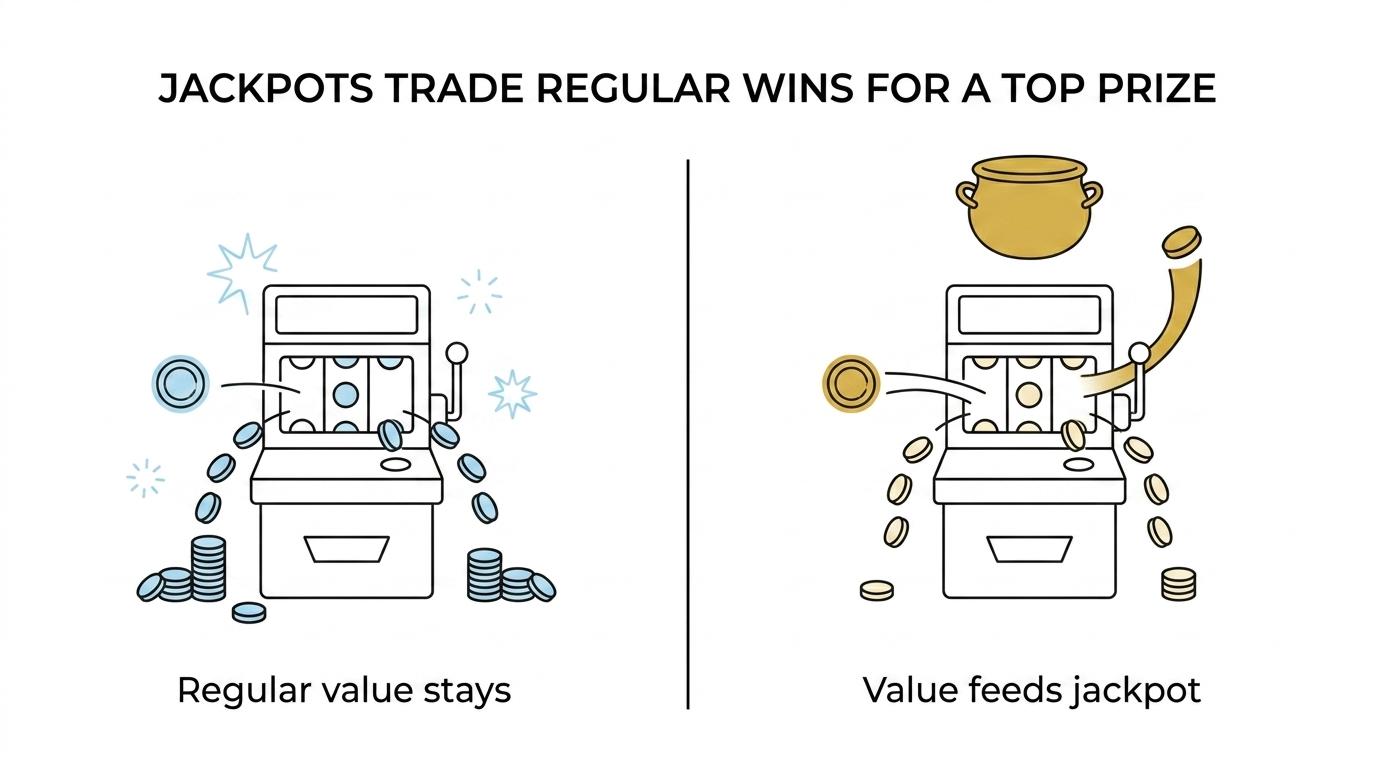 Side-by-side comparison of a standard slot, a fixed jackpot pokie, and a progressive jackpot pokie, showing wager flow, RTP pressure, volatility, and typical session feel.
The jackpot is not just an extra on top.
In practical terms, players are usually comparing three models:
- Standard slot
- Fixed jackpot pokie
- Progressive jackpot pokie
A fixed jackpot has a capped top prize set by the game rules. A progressive jackpot rises over time until someone lands the trigger. That trigger might be a full payline, a bonus wheel, a random event, or a special symbol combination.
Fixed jackpots versus progressive jackpots
Fixed jackpots are easier to price into the base game because the operator and the game design already know the prize amount. Progressive jackpots are less tidy. The pool grows, sometimes across many users, so the prize can become huge while the hit rate remains extremely low.
That is where your odds start to change in a meaningful way. Not because the machine is “due”, but because the game is distributing value across a different shape of outcomes.
RTP in jackpot pokies: why the base game can pay less
RTP, or Return to Player, is one of the most useful figures when comparing pokies. It describes how much a game is designed to return to players over a very large number of spins. It is not a promise for your next session, your next deposit, or even your next thousand spins.
With jackpot pokies, the key issue is this: if part of every wager contributes to a jackpot fund, that portion is not staying in the base game.
A published Australian gambling research example made this very clear. If a game has a theoretical base RTP of 87% and 5% of each wager goes to a linked jackpot, the base game RTP can fall to 82%. The total value picture depends on the jackpot structure, yet the regular spin experience may feel tighter because part of your stake is funding that distant top prize.
Here is a simple comparison.
Game type | Where part of the wager goes | Likely effect on base game RTP | Volatility | Typical player experience |
|---|---|---|---|---|
Standard slot | Regular paytable only | No jackpot deduction | Low to medium, game dependent | More value kept in normal wins and features |
Fixed jackpot pokie | Regular paytable plus set top prize | Usually more predictable than a progressive model | Medium to high | Top prize exists, but the game is easier to balance |
Progressive jackpot pokie | Regular paytable plus growing jackpot pool | Base game can be lower because of jackpot contributions | High to very high | Big prize appeal, rarer top-end outcomes, more bankroll swings |
This table is only a guide. Each game has its own maths model, and published RTP can be shown in different ways. Some regulators separate the base game RTP from the jackpot component because progressive jackpots are hard to measure in the short term.
After looking at RTP, the next question is usually, “So are jackpot pokies worse?” Not automatically. They are just different. If your goal is longer playtime and steadier feature frequency, a non-jackpot slot may suit you better. If your goal is exposure to a life-changing prize, you are accepting that some of the game’s value may be parked in a remote outcome.
Single-spin odds online: why past results do not matter
One of the most persistent myths in pokies is that a machine gets hot after a run of losses, or cold after a big hit. Official gambling guidance repeatedly states the opposite for random machines: the odds for the current spin are not changed by previous wins or losses.
That matters even more in jackpot games, because long dry stretches can tempt players into false patterns.
A spin that follows fifty losses has the same odds as a spin that follows a jackpot celebration, assuming the game rules and stake level are unchanged. RTP is a long-run average, not a spin-by-spin refund policy.
A few ideas are worth keeping in mind when people talk about “better timing”:
- RTP means long-run average: it describes game design over many plays, not what you should expect in one sitting.
- Random spins stay random: losses do not build pressure towards a win.
- Jackpot size changes value, not spin memory: a larger progressive pool can make the top prize more attractive, but it does not mean the next trigger is closer.
- Session results can vary wildly: short play can sit far above or far below published RTP.
This is why chasing losses on jackpot pokies can be especially risky. The long-tail prize creates emotional momentum, while the maths stays indifferent.
Volatility in progressive jackpot games: why the swings feel heavier
Volatility tells you how wins are distributed. A low-volatility game tends to produce smaller, more regular returns. A high-volatility game tends to hold value back and release it through rarer, larger wins.
Progressive jackpot pokies are usually on the higher end of that scale. The jackpot itself is infrequent and large, and that feature influences the feel of the whole game. You may get fewer base-game rescues, longer losing stretches, and more dramatic bankroll movement.
This is one reason two games with similar published RTP can feel completely different.
A 96% standard slot with medium volatility may provide a steadier session than a 96% jackpot slot with a chunky progressive component. On paper, the long-run RTP figure looks similar. In practice, the second game may ask for more patience, more bankroll, and more tolerance for sharp variance.
That trade-off is often missed in marketing copy, where the jackpot takes centre stage. For a serious comparison, volatility belongs right next to RTP.
Online pokies legality in Australia: what the rules say
Australian readers also need the legal context, because it directly affects where and how these games may be offered. Under Australian law, online pokies and other casino-style games offered to people physically in Australia are prohibited interactive gambling services.
The Australian Communications and Media Authority, or ACMA, administers enforcement measures that include a website blocking scheme aimed at illegal offshore gambling sites. Complaints can also be made where prohibited gambling activity is offered or advertised online to people in Australia.
This does not change the maths of jackpot pokies, yet it does change the practical reality for Australian consumers. Before comparing RTP, jackpots, or bonus mechanics, the first filter should be legality.
Comparing jackpot pokies: practical checks that matter
When players focus only on the prize meter, they miss the details that shape the real playing experience. A better comparison starts with the base game and works outward.
If a game page or information screen makes the jackpot prominent but says little about RTP or volatility, that is a warning sign. You are being shown the dream before the cost.
A sensible checklist looks like this:
- Published RTP: look for the theoretical RTP and whether it refers to the base game only or includes jackpot value.
- Jackpot type: fixed and progressive jackpots behave very differently.
- Trigger rules: check whether the jackpot needs a max stake, a bonus round, or a rare symbol combination.
- Volatility rating: higher volatility usually means longer dry spells.
- Jurisdiction and legality: confirm whether the service can lawfully be offered where you are.
- Short session limits
- Clear bankroll cap
- Transparent bonus terms
One more point deserves attention. Some platforms publish live RTP statistics or recent payout information. Those figures can be interesting, yet they do not replace theoretical RTP and they do not change your individual spin odds. Live data is a snapshot, while the maths of the game remains the real baseline.
Bankroll expectations for jackpot pokies
Jackpot games often compress a lot of perceived value into a prize that most players will never hit. That does not make them bad games. It means your expectations need to match the game design.
If you want more spins, more feature rounds, and more visible feedback from your bankroll, standard slots or lower-volatility pokies tend to suit that style better. If you are comfortable with long stretches of little return in exchange for a remote shot at a very large prize, jackpot pokies are built for that appetite.
The difference is strategic as much as mathematical.
A player who mistakes a jackpot game for a normal slot with a bonus prize attached may feel constantly surprised by the drain on funds. A player who recognises the trade-off can make calmer choices about stake size, session length, and whether the prize pool is worth the cost.
That is the real dividing line between jackpot pokies and standard slots online. The jackpot changes where some of the game’s value goes, how the game feels moment to moment, and how patient a player needs to be. When you read the numbers through that lens, the odds stop looking mysterious and start looking exactly as they are: structured, fixed per spin, and shaped by the price of chasing the top prize.