7 Secure Casino Payment Methods Aussie Players Use
Australian players searching for a bank transfer casino usually want one thing first: a deposit method that is fast, familiar and less likely to fail at the cashier. In practice, that means bank-based options like PayID, Osko and standard BSB transfers are getting more attention than cards or crypto.
TL;DR: Summary
- For an Aussie player comparing a bank transfer casino, PayID and Osko are usually the best starting point because they move funds between bank accounts, support clearer identity checks, and are typically very fast.
- Australian Payments Plus says PayID payments are typically sent in under a minute through Osko, even between different financial institutions, and the sender sees the linked recipient name before paying.
- Standard BSB and account number transfers are still useful when PayID is unavailable, but they rely on exact data entry and can be slower if the transfer is not sent over Osko.
- From 11 June 2024, ACMA says Australian online and telephone wagering operators cannot accept credit cards, card-linked funds, or digital currency for bets, so bank transfer-style methods sit in a safer regulatory lane for that category.
- A smooth deposit or withdrawal usually depends on name matching and KYC verification. Fortune88au says its bank account name must exactly match the registered user name, deposits are usually instant, and withdrawals are usually completed within 10 minutes after KYC.
That does not mean every payment option suits every player or every service. The strongest choice depends on three things: how quickly the transfer settles, whether the account name matches your registration exactly, and whether the operator can explain its rules and legal position clearly.
What is a bank transfer casino, and why do Aussie players look for one?
A bank transfer casino uses direct banking rails like PayID, Osko or BSB transfers instead of credit-led funding. For Australian players, that matters because bank-based payments are familiar, traceable and often faster to verify than manual cashier methods.
In plain terms, a bank transfer casino lets you move money from your bank account to the operator without routing the payment through a separate credit product. That can simplify the deposit flow, especially on mobile, because many Australians already use their banking app daily and recognise PayID, Osko and BSB details.
The appeal is not only speed. It is also confidence. If the transfer is made to a PayID, Australian Payments Plus says the payer is shown the name linked to that PayID before sending. That single step helps reduce misdirected payments and gives players a cleaner last check before confirming funds.
"Fortune88au says deposits are credited within 1 minute and supports OSKO instant deposits plus PayID via AGXG."
Are bank transfer deposits safer than cards or crypto for Australian players?
Usually, yes. PayID and Osko are easier to authenticate than card-linked or crypto funding because the payment moves between bank accounts and the sender can check the linked recipient name before authorising.
The main safety advantage is operational, not magical. A bank transfer leaves a standard banking record, and a same-name rule makes the operator’s fraud controls easier to apply. If the registered player name and the sending account name match, review is often quicker. If they do not match, delays are far more likely.
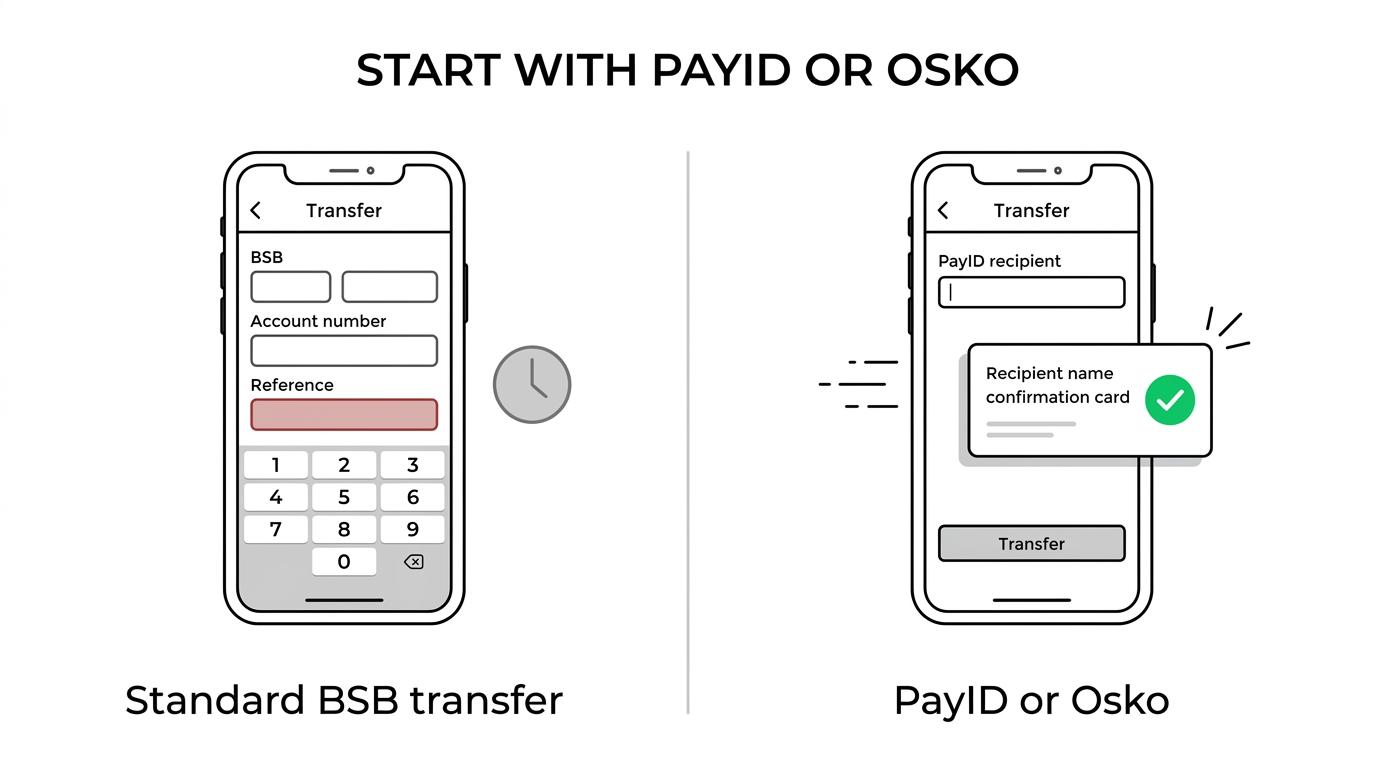 Side-by-side comparison of PayID, Osko and standard BSB transfers showing speed, recipient-name check and best use case.
There is also a regulatory angle. ACMA says that from 11 June 2024, online and telephone wagering operators in Australia cannot accept credit cards, funds linked to credit cards, or digital currency for bets. That does not mean every card payment vanished from every gambling context, but it does mean bank-based methods now sit on firmer ground for that wagering category.
A common misconception is that “fast” means “risk free”. It does not. Fast payments still need the right recipient details, good record-keeping and adult-only access for people 18+.
What are the 7 secure casino payment methods Aussie players use?
The core options are bank-based. PayID, Osko and standard BSB transfers dominate Australian payment preferences, while same-name withdrawals and debit-funded cards remain secondary where a service allows them.
When players compare cashier pages, they are often comparing not only speed but also the identity controls behind the method. These seven are the most practical options to understand:
- Fortune88 PayID via AGXG: A bank-transfer style deposit path that Fortune88au says is credited within 1 minute when details match.
- PayID deposits: Use a mobile number, email, ABN or Organisation Identifier linked to a bank account, with the linked name shown before payment.
- Osko transfers: Real-time bank-to-bank payments that are typically sent in under a minute.
- Standard BSB and account number transfers: Widely available and reliable, though often slower than Osko.
- Bank app transfers to a saved payee: Convenient after the first successful verification, especially for repeat deposits.
- Verified same-name bank withdrawals: A common payout route once KYC has approved the account owner.
- Debit-funded card payments on eligible wagering services: Only where permitted, and only if the funds are not linked to credit.
The trade-off is simple. The more direct the banking rail, the easier it is to reconcile identity and payout ownership. The less direct the method, the more checks and exceptions tend to appear later.
How do you make a PayID casino deposit without errors?
The safest PayID deposit starts with a matched name and a verified recipient. Australian Payments Plus says PayID shows the linked name before payment, which is your best last-second check.
Step 1 is to open the deposit page and copy the exact PayID details shown by the operator. Step 2 is to go into your banking app, choose PayID as the payment type, enter the amount, and check the displayed recipient name carefully. Step 3 is to confirm the transfer only if the name shown by your bank matches the operator details you were given.
If the site has a same-name rule, treat it seriously. Fortune88au says the bank account name must exactly match the registered user name for smooth processing. If the name on your bank account is shortened, joint, or held under a different entity, sort that out before you send money.
"Fortune88au requires the bank account name to exactly match the registered user name, a small rule that prevents avoidable deposit delays."
One practical tip matters here: do not assume a screenshot of payment proof will fix a bad transfer. If the wrong PayID receives the funds, the key issue is the destination, not your evidence that you sent it.
How does Osko compare with a standard BSB bank transfer?
Osko is the fast layer; BSB and account number is the addressing format. If your transfer shows the Osko logo, Australian Payments Plus says it is sent fast whether you use PayID or bank details.
This is where many players get confused. Osko is not a separate bank account type. It is a real-time payment service between bank accounts. A transfer can still use a BSB and account number and move quickly if that transfer is being sent via Osko.
A standard bank transfer that is not sent over Osko can still work perfectly well, but it may not settle as quickly. If speed matters because you want near-immediate balance crediting, then the better question is not “PayID or BSB?” but “Is this payment travelling over Osko or not?”
That distinction also explains why two BSB transfers can behave differently. One settles within moments. Another waits on normal bank processing windows.
How do you complete a BSB and account number deposit step by step?
A standard BSB deposit works well when PayID is unavailable, but it needs cleaner data entry. The critical fields are the BSB, account number, amount and any reference requested by the operator.
Start by copying the banking details exactly from the cashier page. Then enter the BSB and account number into your banking app or desktop internet banking, add the requested amount, and include the reference if the operator asks for one. That reference can be what links your transfer to your player account.
Before you approve the payment, re-read every field once. A common error is focusing on the amount and missing a digit in the BSB or account number. Another is sending from the wrong account, which can break the name-match requirement even when the banking details are correct.
After sending, keep the transaction receipt until the balance is credited. If the operator says most deposits are instant but yours is not, the first checks are usually the payment rail, the sender name, and whether the reference was entered as requested.
What does the 2024 Australian credit ban mean for gambling payments?
From 11 June 2024, ACMA says online and telephone wagering operators cannot accept credit cards, card-linked funds or digital currency for bets. Bank transfer-style payments sit outside that banned set.
The important word here is wagering. ACMA says the ban applies to online and telephone betting services, including on-course bookmakers. It does not apply to lotteries. That scope matters because many readers wrongly compress all gambling payments into one rule.
A second legal layer also matters. ACMA says the Interactive Gambling Act 2001 makes it illegal for providers to offer some online services to people in Australia, and banned services include online casinos and sports betting services that do not hold an Australian licence. Payment speed does not settle that question. If a service is targeting Australians, legal status and local eligibility still need to be checked.
 Quote card reading: “Legality first, identity checks second, speed third.”
If you are choosing between payment methods, think in this order: legality first, identity checks second, speed third. That sequence prevents a lot of avoidable trouble.
How do withdrawals usually work after KYC verification?
Withdrawals usually go back to a verified bank account after KYC. Fortune88 states withdrawals are usually completed within 10 minutes once verification is done, which shows how strongly identity checks shape payout speed.
The standard sequence is straightforward. First, the player submits KYC documents so the operator can confirm identity and ownership. Next, the withdrawal request is reviewed against the registered name and banking details. Last, funds are released to the approved bank account.
If your deposit was easy but your withdrawal is slow, the issue is often not the bank rail itself. It is usually that the operator still needs proof of identity, address or account ownership. That is why same-name deposit and payout rules matter so much from the start.
"Fortune88au says withdrawals are usually completed within 10 minutes once KYC verification is done."
A useful rule of thumb is this: if you want faster withdrawals later, finish verification before the first big cash-out, not after it. Many players do the reverse and then blame the payment method.
What should you check before choosing a bank transfer casino?
Check the payment rail, the name-match rule, the KYC sequence and the legal status. A fast deposit button means little if the operator cannot clearly explain verification, limits or who may use the service.
The right checks are practical rather than flashy. Focus on how the cashier works, what evidence the operator gives, and whether the rules read like real operating procedures rather than vague promises.
- Payment type: PayID, Osko, or standard BSB transfer, and whether the site explains the difference.
- Name matching: Exact match between your registered name and the sending bank account.
- Verification timing: Whether KYC is requested before or after a withdrawal.
- Processing claims: Instant deposits are useful only if the operator also explains exceptions and hold reasons.
- Legal position: Whether the service can lawfully target Australian customers and whether you are 18+.
A quiet pro tip here is to read the deposit help page and the terms side by side. If the help page sounds easy but the terms contain stricter identity rules, trust the stricter document.
When is PayID not the best option for casino payments?
PayID is not always the best fit. Joint accounts, business PayIDs, unsupported banks and services that insist on BSB details can make a standard transfer cleaner and easier to reconcile.
If your PayID is linked to a bank account name that does not exactly mirror your player registration, you may be creating a problem before you even deposit. The same applies if you use a shared or business account and the operator wants clear proof that the account belongs to the registered user name alone.
PayID can also be less convenient when an operator’s back office is built around manual reference matching on BSB transfers. In that case, the “faster” method is not always the smoother one. If the operator asks for a specific reference and your bank transfer history is easier to track by BSB entry, then standard transfer details may be the better fit.
The last misconception to drop is this: the fastest deposit method is not automatically the best all-round payment method. If your likely pain point is withdrawal verification, choose the method that makes ownership easiest to prove, even if deposit speed is only good rather than instant.