8 Best Pokies Traits Aussie Players Check Before Play
When Australians search for the best pokies, the smartest answer is not “the biggest jackpot” or “the hottest machine”. It is the game and service that show clear odds, lawful status, feature rules, and practical spending controls before a single spin.
TL;DR: Summary
- The best pokies for Aussie players are the ones with transparent odds, clear feature rules, lawful operator status, and usable spending tools, not just large jackpots or flashy free spins.
- Victorian guidance says every pokie result is random, losses are expected over time, and bonus features, jackpots, and win clips can make wins look more common than they are.
- Before using any online gambling service in Australia, ACMA says to check whether it is legal and on the register of licensed interactive gambling providers. If it is not on the register, avoid it.
- A machine’s return to player or theoretical RTP matters, but it is a long run model. The Victorian 87% minimum for venue pokies is not 87% back to each player.
- The most useful pre-play checks are simple: read the info screen, inspect feature triggers and paylines, set money and time caps, and walk away if the operator, odds, or tools are unclear.
- Longer play increases expected losses, and Australian harm-minimisation sources consistently flag pokies as the most harmful gambling form, so “best” should always include control, not only entertainment.
That changes how you compare games. Instead of asking which pokie “pays the most”, ask which one gives you enough information to make a controlled choice, and which one you should skip altogether.
What does “best pokies” actually mean for Aussie players?
The best pokies are transparent, lawful, and easier to control. VGCCC guidance and Gambling Help Online both point to the same filter: check odds, features, and spending tools before you chase jackpots or free spins.
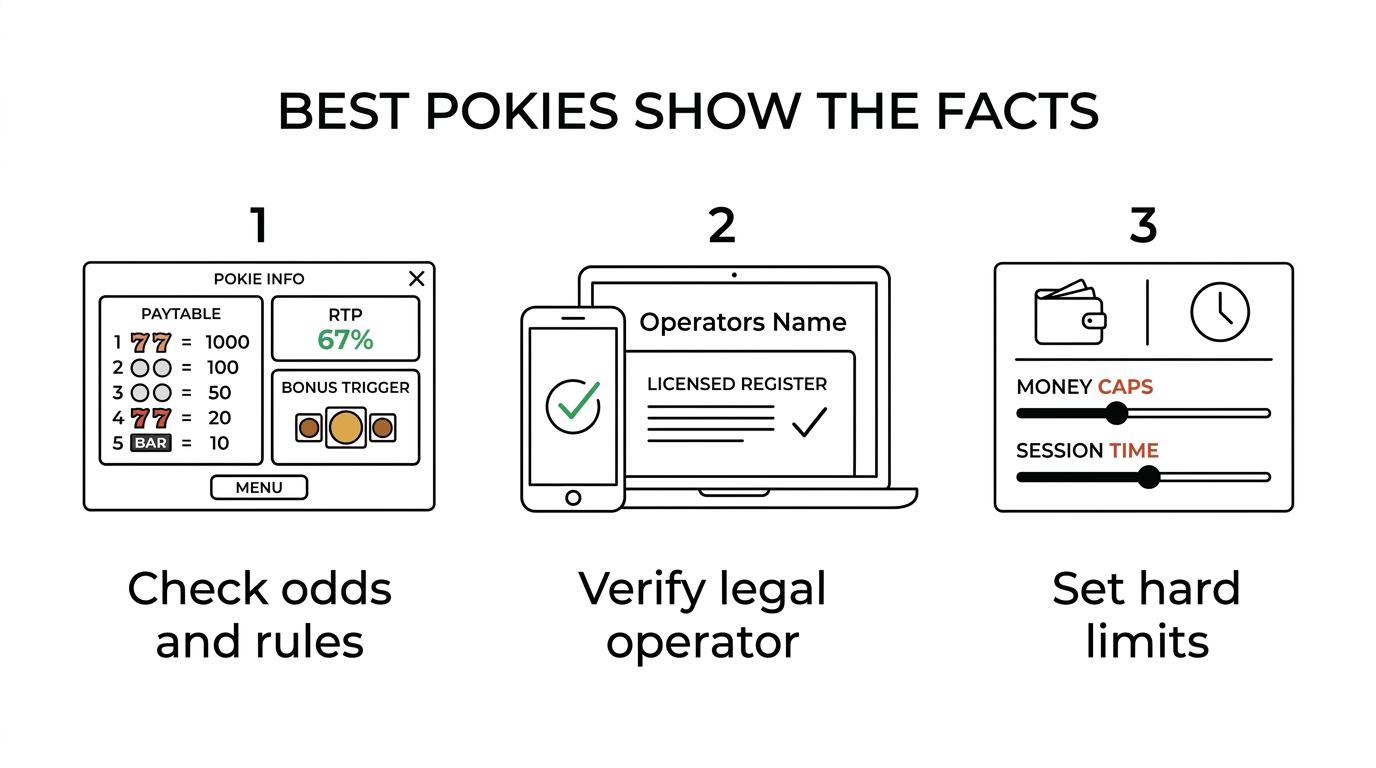 Checklist-style graphic showing the key traits to check before choosing a pokie service.
For venue play, that means using the machine’s information button and reading the paytable, feature rules, and any session tracking. For online play, it means checking the operator’s legal status in Australia, then looking for the same facts in the game lobby or help screen. A “best” pokie is not automatically the one with the loudest branding or biggest banner.
A common misconception is that entertainment value equals better value. A game can feel generous because it has near misses, celebratory sounds, free spins, or a jackpot animation, while still being a losing product over time. Victorian guidance is blunt on this point: results are random, and losses are expected over time.
“Fortune88 highlights live RTP statistics and a mobile-optimised pokies experience, which are practical transparency checks Australian adults 18+ can use before play.”
If you remember one standard, make it this: if the machine or service hides key information, it is not one of the best pokies for informed play.
How do you check whether a pokie service is legal in Australia?
In Australia, legality comes first. ACMA and the Interactive Gambling Act 2001 make the practical test simple: check whether the service is legal and listed on the register of licensed interactive gambling providers.
Step 1 is identity. Look for the operator name, the gambling product type, and any licensing detail shown in the footer, help pages, or account terms. If you cannot tell who runs the service, stop there.
Step 2 is verification. ACMA says consumers should make sure an online gambling service is legal and listed on the register. Services not on the register should be avoided. This matters because brand design can look polished even when the legal footing is weak.
Step 3 is product fit. A registered operator in one category does not turn every gambling product into a legal offering for every player. If the site description, payment flow, or bonus terms seem vague, treat that as a red flag rather than a small paperwork issue.
A good rule is simple: if legality is hard to confirm, the service is not worth your deposit.
What are the 8 best pokies traits Aussie players should check before play?
The eight best pokies traits are operator legality, odds disclosure, feature clarity, and control tools. Those checks beat hype every time because they tell you what the game is, how it works, and how easily you can stop.
Use this list as a pre-play screen, not as a way to justify longer sessions.
- Legal status and operator identity: Confirm the service is legal for Australian consumers and check the operator details before you look at a jackpot meter.
- RTP or theoretical RTP disclosure: A visible return to player figure is a baseline transparency signal, even though it does not predict your next session.
- Clear paytable and symbol rules: You should be able to see what symbols pay, what triggers features, and whether bet size changes access to bonuses.
- Bonus feature detail: Free spins, respins, gamble features, and jackpots should show trigger conditions and any limits in plain language.
- Volatility or prize distribution cues: If a game pushes a huge jackpot, expect trade-offs. Bigger top prizes often mean less frequent meaningful wins.
- Session tracking or limit tools: In venues, look for spending trackers and systems like YourPlay. Online, look for deposit, loss, time, or cooling-off tools.
- Banking and withdrawal clarity: Fast deposits are common. Clear withdrawal rules matter more because they tell you how the operator handles your money after a win.
- Promotion pressure level: Treat personalised ads, bonuses, and referral offers as marketing, not evidence that a pokie is better value or closer to paying out.
The strongest shortlist usually comes from games with more information and fewer surprises.
How do RTP and jackpot size compare when you choose a pokie?
RTP is the better starting metric; jackpot size is the louder marketing number. VGCCC guidance on Victorian machines shows why: return figures describe long run design, while jackpot headlines tell you little about your likely session outcome.
If two legal pokies are both clear about rules, the higher RTP is usually the more useful baseline. If one game advertises a massive jackpot but gives poor information on paytable, feature odds, or bet scaling, that trade-off is usually not worth it.
The most common misunderstanding is the 87% figure on Victorian venue pokies. The guide says a pokie must return 87% to players each year, but that is not 87% to each player. One session can be far above or far below that figure because RTP is a theoretical long run average.
“Fortune88 says it offers live RTP statistics, which is more useful for pre-play screening than a jackpot banner on its own.”
Jackpots still matter if your goal is entertainment style. A jackpot game can be more exciting, but excitement is not the same as better odds or better control.
How do you read a pokie’s info screen in three steps?
A pokie’s info screen is the fastest fact check you have. Victorian machine guidance says the information button shows the odds of winning and the machine’s features.
Step 1 is the paytable. Check what each symbol combination pays and whether paylines or ways-to-win change with your stake. If the paytable is hard to read, that itself is useful information.
Step 2 is the feature page. Look for free spins, wilds, jackpots, respins, and any gamble feature. Read the exact trigger, not the promotional banner. A feature that triggers rarely can still dominate the game’s marketing.
Step 3 is the session-control area. Some machines track spending during a session, and some venues use tools like YourPlay. Online, the equivalent may sit in your wallet, limits, or safer gambling settings rather than inside the game.
Pro tip: screenshots of big wins are not a substitute for the info screen. The info screen tells you how the game is built; a clip tells you only that one person had one short result.
Are bonus features and free spins a sign of better odds?
No, bonus features and free spins are entertainment mechanics, not proof of better odds. VGCCC and Gambling Help Online both warn that features, jackpots, and win clips can make wins look more frequent than the full picture.
A game with frequent small features can feel lively because it breaks up losing spins. A simpler game may feel flat even if its RTP is similar. That is the first trade-off: player experience versus perception. The second trade-off is time. Features can keep you engaged longer, and longer play raises expected losses.
The national gaming machine standard adds another useful detail. A gamble feature can allow a maximum of five attempts after a win, and the player must be able to exit without committing winnings. Theoretical RTP for the gamble feature is 100%, but that does not turn the full machine into a fair or profitable product. It only describes that specific sub-feature’s design.
Common misconception: “more free spins” does not mean “better pokies”. It often means “more reasons to keep spinning”.
How should you set limits before a pokie session?
The right limit is a hard cap set before play starts. Gambling Help Online treats pokies as the most harmful gambling form, so the safest plan is one that makes stopping automatic rather than emotional.
Step 1 is to set two limits, not one: a money limit and a time limit. If either limit is reached, the session ends. This matters because chasing time can be as costly as chasing losses.
Step 2 is to separate promotions from your own funds in your mind. A free bonus no deposit offer, cashback message, VIP reward, or leaderboard prompt can change how much risk feels “acceptable”. It is still gambling activity, not free money.
Step 3 is to review actual spend, not remembered spend. If the service offers account history, session statements, or safer gambling tools, use them. In Victorian venues, look for tracking tools and YourPlay where available.
“Fortune88 combines promotions, VIP rewards, referral rewards, and fast withdrawal processing, so a player’s best defence is to set hard money and time caps before opening a game.”
If you want a practical threshold, use an amount you would be fully comfortable losing in one sitting, then make the limit non-negotiable.
Why doesn’t a machine become “due” for a win?
A machine is never due. VGCCC says the odds do not change no matter how many times you press the button, and a machine is not due for a win.
That is because pokies use random number generators. Each spin is a new event, independent of the last one. A long losing streak does not “load” the next spin with extra value, and a recent jackpot does not make the machine cold.
 Quote card with the words: A machine is never due.
If you catch yourself thinking “it has to hit soon”, stop and test the logic. If the mechanism is random, then past spins cannot force a future payout. The same warning applies to multi-bets or higher-stake chasing. More lines or more stake can change prize structure, but they do not beat the underlying odds.
One more trap is selective memory. People remember the near miss, the feature tease, and the friend’s big win. They forget the long run of ordinary losing spins that paid for those moments.
When should you stop or skip a pokie altogether?
You should stop or skip when the legal status, odds, or control tools are unclear. ACMA, VGCCC, and responsible gambling guidance all support that approach because uncertainty nearly always works against the player.
Before you play, check for warning signs that the game or service fails the basics.
- No legal clarity: the operator identity or Australian status is hard to verify.
- No usable info screen: RTP, paytable, or feature rules are buried or missing.
- No spending tools: there is no easy way to set limits, track a session, or cool off.
- Too much promo pressure: personalised offers, leaderboards, or win clips are pushing urgency.
- Chasing behaviour: you want to recover losses, extend time, or raise stakes to “get even”.
The strongest harm-minimising cue is often discomfort. If the service feels harder to leave than to enter, it is already failing one of the key traits that define the best pokies for Australian players.