How Casino Tournaments Compare With Leaderboards Online
Online competition has changed the feel of digital casino play. A standard session used to be mostly private: pick a game, set a budget, spin or deal, and log out. Tournaments and leaderboards add a public layer. Progress becomes visible, prizes become ranked, and every result can feel connected to a wider field of players.
That shift matters because a casino tournament and an online leaderboard may look similar at first glance, yet they create very different rhythms. One is usually a set event with a start and finish. The other often runs continuously, rewarding consistency over time. For Australian players, the difference is not only about style or prize structure. It also touches account rules, payment settings, and the broader regulatory climate around online gambling.
What a casino tournament means online
A casino tournament is generally a time-limited competition built around a specific game, a group of games, or a set scoring system. Players enter during a defined window and try to finish above others before the event closes. The prize pool may be fixed, tiered, or linked to final rank.
In practical terms, tournaments create urgency. A session feels more focused because every spin or round contributes to a race. Some tournaments measure raw winnings. Others award points based on stake size, hit frequency, or game-specific outcomes. The main appeal is the event format itself: everyone is chasing a result within the same timeframe.
That structure tends to attract players who enjoy pace, milestones, and clear finishes.
- Short campaign
- Defined prize pool
- Fixed start and end time
- Rank-based rewards
- Stronger sense of event play
How online leaderboards usually work
Leaderboards usually feel less like a single event and more like an ongoing ladder. A platform may update rankings daily, weekly, or monthly. Players climb by collecting points across eligible games, meeting wagering targets, or maintaining steady activity over a longer period.
This longer timeframe changes behaviour. Instead of pushing hard in a narrow event window, a player may spread activity across many sessions. Leaderboards often suit regular players who prefer to build position gradually rather than rely on a short burst of form.
They can also be closely tied to broader loyalty systems. On some sites, leaderboard points sit alongside VIP levels, reload offers, or monthly promotions. That means the value of a leaderboard is not only the final prize. It can also be the status and visibility that come from repeated participation.
Casino tournaments vs online leaderboards at a glance
The easiest way to separate the two is to look at pace, pressure, and reward timing.
Feature | Casino tournament | Online leaderboard |
|---|---|---|
Format | Time-limited event | Ongoing or recurring ranking |
Best for | Players who like short competitive bursts | Players who prefer steady accumulation |
Reward timing | Usually at the end of the event | Often daily, weekly, or monthly |
Emotional feel | Urgent and intense | Persistent and strategic |
Session style | Concentrated play windows | Repeated play across many sessions |
Risk of overchasing | Can rise near the finish line | Can rise through long-run grind behaviour |
Fair-play focus | Equal event conditions matter | Consistent point tracking matters |
A tournament can feel exciting because it has a clear story. You enter, compete, and finish. A leaderboard has a different attraction. It creates continuity, giving players a reason to return and keep building rank.
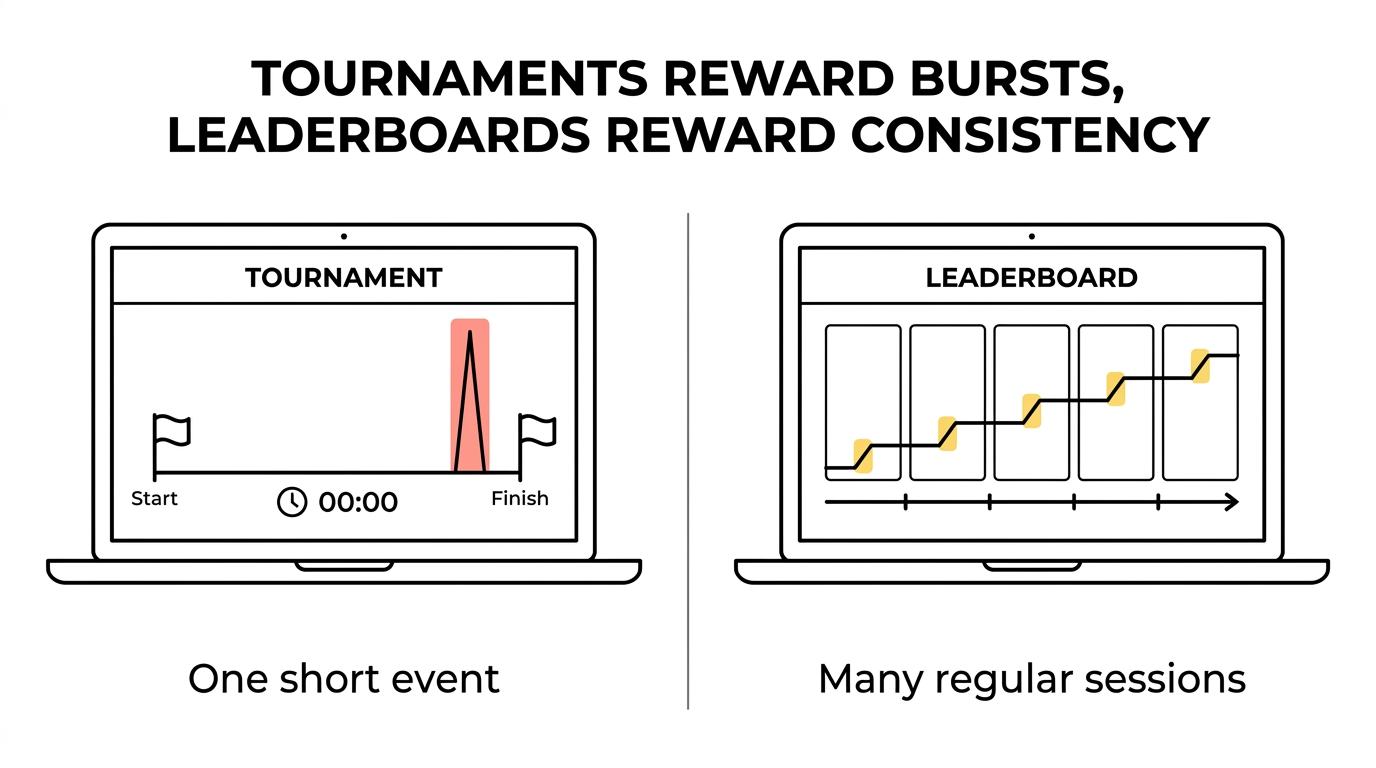 Side-by-side comparison of an online casino tournament and an online leaderboard, showing differences in timing, play style, rewards, and competitive pressure.
Neither format is automatically better. The better option is the one that fits a player’s habits, budget, and tolerance for competitive pressure.
Why competition changes player behaviour in online casino formats
Competition does more than add entertainment. It can change spending, confidence, and decision-making. Research outside traditional casino settings gives useful clues here.
A 2016 PubMed-listed study on tournament bracket contests found that higher self-ratings of winning chances increased maximum willingness to wager, even though those stronger self-beliefs did not improve actual performance. That pattern matters because casino tournaments and leaderboards can create a similar mental frame. When players see a climb in ranking, they may feel more in control than the underlying game really allows.
Another study indexed on PubMed in 2025 reported that inducements increased betting spend by more than 10% in a randomised online experiment, and nearly halved the number of participants who chose not to bet. Participants with evidence of problem gambling were hit harder by those inducements, and were more likely to choose poor bets. The message is straightforward: rewards and competitive prompts can meaningfully shift behaviour.
A 2021 PubMed-listed experiment on a social casino game found that participants in the reward condition placed more bets and used higher credit amounts than the control group. Later, those who chose to gamble with compensation money showed higher problem-gambling severity and stronger cravings.
These findings do not mean tournaments or leaderboards are inherently negative. They do show why structure matters. Competitive systems can be exciting and motivating, yet they also increase intensity. A smart player treats that intensity with respect.
After keeping that in mind, a few patterns become easier to spot:
- Momentum effect: a good start can tempt players to push harder than planned
- Rank pressure: being close to a prize tier can change stake decisions
- Return bias: longer ladders encourage repeated check-ins and extra sessions
- Illusion of control: visible progress can feel like skill is driving outcomes more than chance actually allows
Australian regulation and payment rules for online gambling competition
Australian players also need to think about the legal and operational setting around any competitive casino-style feature. The Australian Communications and Media Authority states that businesses operating online gambling services must comply with the Interactive Gambling Act 2001. ACMA also maintains information on licensed interactive wagering providers and has continued enforcement against illegal services.
That enforcement has been active. ACMA reported in 2026 that 1,640 illegal gambling websites had been blocked since the first blocking request in November 2019, and that more than 230 illegal services had withdrawn from the Australian market since 2017. The regulator has also warned that illegal gambling services may lack key customer protections, which matters a great deal when prizes, balances, and identity checks are involved.
Payment settings are another part of the picture. ACMA states that, from 11 June 2024, online and telephone wagering operators cannot accept credit cards or digital currency for bets. Players should always check the rules that apply to the gambling product they are using and confirm that a provider’s payment methods match current Australian requirements.
For tournament and leaderboard players, regulation touches several practical points:
- Provider status: check whether the service sits within the relevant Australian legal framework
- Payment method: avoid assuming every deposit option is permitted for every gambling product
- Identity controls: prize claims often depend on account verification
- Customer protection: blocked or illegal sites can create real payout and dispute risks
Account controls and fair play in casino tournaments
Fair competition depends on strong account rules. In a tournament or leaderboard, even a small breach can distort results for everyone else. Multiple accounts, collusive behaviour, or unclear bonus conditions can all weaken trust in the format.
That is why one-account-per-person rules matter so much. Fortune88’s published terms state AUD-only play, a minimum deposit of AUD 10, a minimum withdrawal of AUD 50 excluding applied bonus, and a prohibition on multiple account registrations. Even without focusing on a single platform, these examples show the kinds of controls that support clearer administration of competitive promotions.
A strict account framework helps in several ways:
- One account rule: reduces the risk of duplicate entries and prize manipulation
- AUD-only play: keeps balances and promotional calculations in one currency
- Minimum withdrawal settings: gives players a clearer view of cashout thresholds
- Fast payment processing: matters more when tournament prizes create quick withdrawal requests
For players, the lesson is simple. Read the rules before joining. In competitive formats, small details carry more weight than they do in casual play. Entry conditions, eligible games, point formulas, tie-break rules, excluded bonuses, and withdrawal limits all shape the real value of the event.
Choosing between a casino tournament and a leaderboard online
The best choice depends less on prize size and more on how a person likes to play. Some players thrive in a sharp, focused window. Others prefer to spread their activity over days or weeks and avoid the rush of a countdown.
A tournament can suit players who like event energy and a clean finish line. The rules are usually easier to grasp because the competition is self-contained. You know when it starts, when it ends, and what rank you need to chase.
Leaderboards often suit players who already log in regularly. They can make ordinary sessions feel more purposeful, especially when paired with VIP levels or monthly campaigns. Yet that same continuity can also blur the line between planned play and routine top-up play, which is why budget discipline matters.
If the choice is not obvious, compare your habits against the format:
- Choose a tournament if: you prefer short bursts, fixed goals, and less month-long commitment
- Choose a leaderboard if: you enjoy consistency, regular logins, and tracking position over time
- Pause either format if: chasing rank starts to override your pre-set spend or session limit
What experienced players watch before entering competitive casino play
Seasoned players often pay more attention to mechanics than to headline prizes. A large prize pool can look attractive, but the scoring method and field size may matter more.
If points are based mainly on turnover, heavy-volume players may have a natural edge. If rankings depend on a best-hit model or multiplier score, volatility matters more. If a leaderboard resets monthly, consistency may beat short-term aggression. Reading those mechanics carefully gives a far better picture than marketing language alone.
It also helps to treat visibility as part of the product. A leaderboard can create a satisfying sense of progress. A tournament can create a strong pulse of excitement. Both are valid forms of entertainment when approached with clear limits and realistic expectations. The strongest position is not just finding the most attractive prize. It is choosing the format that matches your style without pushing you away from disciplined play.
For Australian players, that mindset works especially well when paired with sensible checks: confirm the provider’s status, review payment rules, stick to one verified account, and know the event terms before the first spin or round. When those basics are in place, the difference between a tournament and a leaderboard becomes much easier to judge, and much more enjoyable to use well.