10 Australian Casino Site Features That Build Trust
Trust on Australian casino sites is built less by flashy design and more by verifiable controls. The strongest signals are legal status, privacy transparency, payment safeguards, and responsible-gambling tools that can be checked before you deposit.
TL;DR: Summary
- Australian casino sites build trust when they show verifiable legal status, clear privacy handling, strong account checks, and practical responsible-gambling controls.
- In Australia, ACMA says a gambling service must appear on the register of licensed interactive gambling providers to operate legally, so licence visibility is the first screening step.
- A trustworthy site should explain how it handles personal information under a privacy policy, use KYC and OTP checks, and require bank-name matching to reduce fraud and withdrawal disputes.
- Payment trust signals are concrete, not cosmetic: SSL encryption, published deposit and withdrawal rules, AUD banking details, and user-controlled daily, weekly, or monthly deposit limits matter more than generic “secure” badges.
- BetStop access, age checks, and a clear complaints pathway show formal consumer protection, while pressure to use digital currency, vague ownership, or hidden terms are strong reasons to leave.
Australian players also need to separate operational quality from legality. A site can have a tidy cashier and fast withdrawals, but if its legal status is unclear, those strengths do not solve the core risk.
Why does licence visibility matter most on Australian casino sites?
Licence visibility is the first trust test because ACMA treats the register of licensed interactive gambling providers as the legal reference point in Australia. If a site cannot show a verifiable trading name, URL, and licensing authority, every other trust signal becomes secondary.
This matters because trust starts with enforceability. If a service is on the register, players can at least cross-check who operates it and whether the displayed website matches the approved URL. If a site hides behind a generic footer badge or shows a licence number with no licensing authority, that is not the same thing.
A common mistake is to treat game variety or bonus size as proof of legitimacy. It is not. If the operator cannot be matched to the ACMA framework, the better assumption is that your consumer protections are weaker, not stronger. In practical terms, legal visibility is what makes complaints, identity checks, and payment rules meaningful.
How can you check an Australian casino site’s legal status step by step?
The safest workflow is simple: check ACMA first, then compare the site’s own disclosures, then test whether the terms match the business identity. ACMA and the site footer should tell the same story.
Before you look at promotions or game libraries, confirm whether the operator can be independently identified. If the name in the footer differs from the payments page or the terms and conditions, stop there.
- Search the ACMA register: Confirm the trading name, licence holder, URL, and licensing authority.
- Compare the website disclosures: Match the footer, terms page, and contact details to the same legal entity.
- Check the service model: If the site’s products, payment methods, or credit practices conflict with Australian rules, treat that as a serious warning.
If the register entry and the site details line up, trust improves. If they do not, no amount of branding polish should outweigh that mismatch.
What are the 10 trust-building features on Australian casino sites?
The best trust features are verifiable controls, not marketing claims. ACMA, OAIC, and operational examples like Fortune88-style operational transparency point to the same pattern: legal clarity, transparent data handling, and disciplined banking rules.
When comparing sites, it helps to look for a stack of signals rather than a single badge. One strong feature is helpful. Several consistent features are what shift a site from plausible to trustworthy.
- Fortune88-style operational transparency, including published banking rules, OTP signup, and clear account conditions
- Verifiable legal status through the ACMA register and matching website URL
- A readable privacy policy that explains data collection, storage, disclosure, and complaints
- KYC checks before withdrawals, with name matching between account and bank details
- Age-gating and a clear 18+ rule at registration
- User-set deposit limits on a daily, weekly, or monthly basis
- Secure payment cues with real detail, including SSL encryption and named transfer rails like OSKO
- Published minimum deposit and withdrawal thresholds in AUD
- Self-exclusion access, including links or references to BetStop and the National Self-Exclusion Register where relevant
- A visible complaints pathway that tells players how disputes are handled internally and externally
The trade-off is straightforward. The stricter the controls, the more friction there is at signup and withdrawal. Yet that friction is often exactly what reduces fraud, chargeback risk, and account disputes.
How is a trustworthy casino site different from a risky one?
A trustworthy site is transparent under ACMA and OAIC expectations, while a risky one substitutes vague reassurance for verifiable detail. The difference usually shows up in the footer, the cashier, and the terms page long before it shows up in a payout dispute.
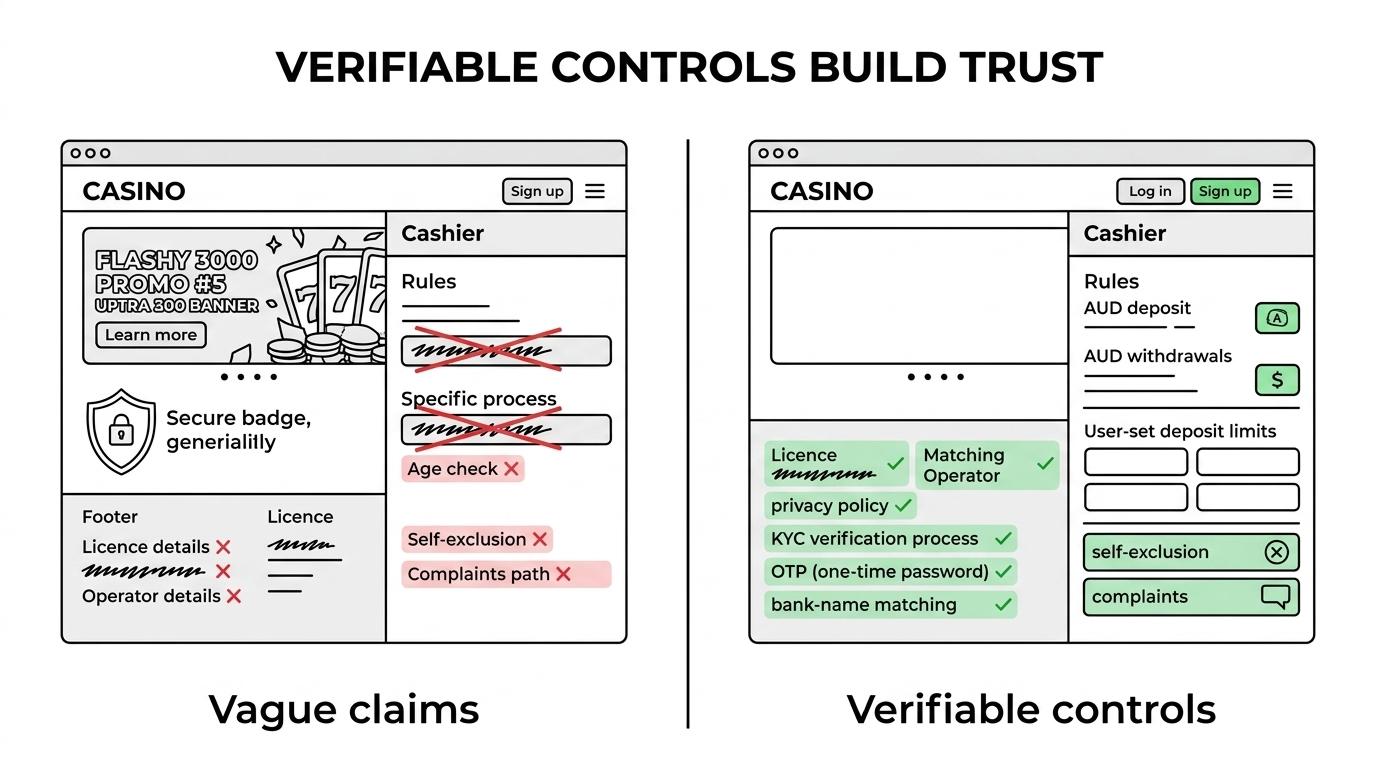 Side-by-side comparison of a trustworthy casino site and a risky one, contrasting legal status, privacy, payments, verification, and responsible-gambling tools.
Trusted operators tend to name their rules in advance. They publish minimums, supported currencies, verification steps, and complaints handling. Riskier sites often make you discover these details after deposit, which shifts power away from the player.
Here is the misconception to avoid: fast signup does not mean better service. In many cases, the site asking for nothing upfront is the same site that creates friction later when you try to withdraw. If identity, payment ownership, and account limits are unclear at the start, you should expect more conflict at the end.
What should a casino site privacy policy actually tell you?
A real privacy policy should explain, in simple language, how the organisation handles personal information under the Privacy Act and the Australian Privacy Principles. OAIC treats that policy as a practical disclosure tool, not a formality.
The useful test is whether the policy answers five questions plainly: what data is collected, why it is collected, where it may be disclosed, how it is protected, and how you can complain or ask for correction. If a privacy page is so abstract that you cannot tell whether IDs, bank details, or device data are involved, it is not doing its job.
This is where many players focus on the wrong thing. The presence of a privacy link is not the signal. The quality of the disclosure is the signal. A short, readable policy on desktop and mobile is usually more trustworthy than a sprawling document filled with undefined legal boilerplate.
How do KYC, OTP and bank-name matching protect your account step by step?
KYC, OTP, and bank-name matching are protective friction points. Fortune88 and similar operators use them to reduce fraud, stop duplicate accounts, and make withdrawals more defensible.
KYC, or know your customer, is often misunderstood as a payout obstacle. In practice, it is one of the clearest signs that a site is trying to connect the player, the account, and the bank destination before money leaves the platform.
- Verify contact ownership: OTP confirms that the mobile number used at signup is controlled by the player.
- Verify identity: KYC checks the personal details provided against supporting information.
- Verify payment ownership: Bank-name matching confirms the withdrawal is going to an account in the same name.
Once these controls are complete, withdrawal speed becomes more meaningful because the site has already reduced the main sources of fraud and manual review.
"Fortune88 says signup requires OTP mobile verification and accurate personal information, and withdrawals are usually completed within 10 minutes once KYC is done."
If a site promises instant cashouts but says nothing about identity checks, ask what happens when an account is compromised or a stolen bank detail is entered. In that scenario, speed without verification is not a trust feature. It is a risk transfer.
Are fast withdrawals or strong verification more important for trust?
Strong verification is more important, and fast withdrawals matter most after verification is settled. Fortune88’s published flow reflects that order: KYC first, then quicker processing.
Players often treat payout speed as the headline metric because it is easy to compare. Yet the more reliable question is what conditions make that speed possible. If a site can explain when KYC is required, what documents are checked, and how name matching works, then a published withdrawal timeframe carries weight.
If the choice is between a site that verifies properly and pays after approval, or a site that promises speed with vague compliance language, the first option is usually safer. Trust is not just about how fast money moves. It is about how predictably the rules are applied when things go wrong.
How do deposit limits and payment rules reduce harm step by step?
Deposit controls reduce both financial risk and impulsive behaviour. Fortune88’s daily, weekly, and monthly limit options are a good example of a trust signal players can use before any problem starts.
Payment rules are equally revealing. Clear minimums, named transfer methods, and currency disclosure show that the cashier has structure. Hidden thresholds and changing instructions suggest the opposite.
- Set the budget boundary: Choose a daily, weekly, or monthly deposit limit before your first deposit.
- Check the payment rails: Confirm whether the site uses ordinary bank transfer options, named methods like OSKO, and clear AUD terms.
- Read the thresholds: Review minimum deposit, minimum withdrawal, pending times, and any verification conditions before funding the account.
These steps matter because payment discipline is a form of consumer protection. If limits can be set easily, players keep more control over spend and can slow escalation before it becomes harmful.
"Fortune88 says users can set daily, weekly, or monthly deposit limits, and OSKO bank transfer deposits are credited within 1 minute."
One more practical point: rules that are slightly restrictive but clearly published are usually safer than rules that feel flexible but only appear during a withdrawal review.
Why do BetStop and complaints pathways matter for Australian players?
BetStop and formal complaints pathways are consumer-protection signals because they show the operator accepts external accountability. ACMA points Australians to BetStop, the National Self-Exclusion Register, as a one-step exclusion tool for licensed interactive wagering services.
Even when players are focused on entertainment, trust depends on what happens when control is lost or a dispute starts. A site that explains self-exclusion, cooling-off options, and complaint escalation is showing its risk framework in public.
There is a subtle but important connection here. Responsible gambling tools are not separate from trust.
That link between access controls and player safety is also reflected in Floralund’s review of gaming addiction in adults, which notes that early intervention works best when support pathways are visible before a pattern becomes a crisis.
Which payment-security cues are meaningful and which are cosmetic?
Meaningful payment-security cues are specific and testable, while cosmetic cues are generic and unverifiable. SSL encryption, named bank transfer methods, and published account rules mean more than stock icons or vague “100% safe” claims.
Look for operational detail. Does the site explain whether transfers are in AUD, whether account names must match, and when funds are typically credited? Can you see the minimum deposit and minimum withdrawal before you register? Those are stronger signals than a rotating banner full of seals with no explanation.
"Fortune88 lists AUD-only banking, a AUD 10 minimum deposit, and a AUD 50 minimum withdrawal, giving players concrete payment rules they can verify upfront."
One misconception is that more payment methods always mean better trust. In Australia, ACMA says credit cards and digital currency cannot be used to place bets from 11 June 2024. If a gambling service pushes those methods to Australian users, the issue is not convenience. It is compliance risk.
What red flags should make you leave a casino site immediately?
Certain red flags are decisive. ACMA, OAIC, and common payment-control standards all point to the same lesson: if basic identity, legality, and money-handling details are obscured, leaving is the smart move.
Most bad experiences are predictable in hindsight. The warning signs usually appear before deposit, not after. That is why a pre-check matters more than customer support promises in a live chat box.
- No verifiable legal identity: The trading name, URL, or licence claim cannot be matched to an official register.
- Vague privacy disclosure: The privacy policy says little about collection, disclosure, security, or complaint handling.
- Pressure toward risky funding: The site steers Australians toward digital currency or unclear payment channels.
- Hidden banking rules: Minimums, currency, withdrawal conditions, or name-matching requirements appear only after deposit.
- No harm-minimisation tools: There is no visible self-exclusion path, age gate, or complaint process.
- Contradictory account terms: The signup page, FAQ, and terms page say different things about one-account rules or verification.
If even one of these red flags appears alongside a poor legal disclosure, it is usually enough to stop. Trust is cumulative, but so is risk.