8 Pokies Review Checks Aussie Players Use Before Play
For Australian players, a good pokies review starts well before the first spin. ACMA’s guidance makes the first question simple: is the operator legal in Australia, and what customer protections apply if something goes wrong?
TL;DR: Summary
- In pokies reviews Australia, the first check is legality: ACMA says illegal online gambling services can include pokies and casino-style games when the operator is not licensed in Australia.
- If a site is unclear on legal status, or appears on ACMA’s blocked-gambling radar, treat that as a stop sign because winnings can be withheld and Australian regulators may have limited ability to help.
- A practical pre-play review should then check safer gambling tools, KYC verification rules, minimum deposit, minimum withdrawal, and bonus terms that can change whether funds are easy to access.
- Site FAQ and T&Cs matter because they often reveal conditions that directly affect play, including AUD-only banking, minimum withdrawal thresholds, name-match bank rules, and full line bets on slots.
- If a review has to choose between a bigger bonus and clearer customer protections, clearer protections usually win because they affect legal recourse, payments, self-exclusion, and account safety.
That shifts the review process from hype to risk control. For most adults comparing online pokies sites, the smartest approach is to screen legality, protections, and banking terms first, then look at RTP, bonuses, and game variety once the basics are clear.
Why should legality come first in pokies reviews Australia?
Yes. ACMA makes legality the first filter because illegal online gambling services can accept deposits while leaving Australian players with little practical recourse.
A common mistake is treating a polished app, fast-loading site, or popular affiliate review as proof that an operator is safe. It is not. ACMA says illegal online gambling services can include slots, casino-style games, scratchies, and other services that are not licensed in Australia.
That matters because the downside is not theoretical. ACMA warns that illegal operators can take deposits, make winnings inaccessible, close or move services, or keep withdrawing funds from a bank account without permission. If money access is the real test, legality is the review category that affects every other category.
How do you check whether a gambling operator is legal in Australia?
Start with ACMA and the operator name. If the service is not clearly legal in Australia, treat that as a stop sign, not a minor review note.
Step 1: identify the exact operator and service, not just the brand name on the homepage. Many sites use different domains, white-label arrangements, or mirror pages, so the legal entity matters more than the logo.
Step 2: check ACMA guidance and the register of licensed interactive gambling providers where relevant. ACMA says players should make sure an online wagering service is legal before using it, and that a gambling operator must be on the register to operate in Australia.
Step 3: compare that with the product being offered. If the site is pushing pokies or casino-style games to Australians and the legal basis is unclear, stop the review there. If a site is blocked, recently moved to a new domain, or avoids clear jurisdiction details, that is a stronger warning, not a smaller one.
ACMA also says players can complain if a provider is not on the register or if a licensed provider offers credit or in-play betting. That is useful because it shows reviews are not only about the site’s claims. They are also about what Australian regulators can verify or act on.
What are the 8 pokies review checks Aussie players use before play?
A solid pokies review uses eight checks, from ACMA status to KYC rules. The order matters because payment and protection failures usually cost more than a weak bonus.
Most review pages start with game count, welcome offers, or design. A sharper review starts with the controls that affect whether you can safely deposit, verify, withdraw, pause, or stop.
- Legal status: Check whether the operator is clearly legal for Australian users and whether ACMA guidance raises any red flags.
- Blocked-domain check
- Safer gambling tools: Look for BetStop references, safer gambling tools, account limits, time-outs, and help pathways.
- 18+ age gate and jurisdiction rules
- KYC and name match: Confirm ID checks and whether the bank account name must exactly match the registered name.
- Deposit and withdrawal minimums
- Bonus conditions: Read wagering, expiry, excluded games, and full line bet rules before you rely on a promo.
- RTP, volatility, provider, and mobile play data
That checklist is useful because it follows the real money path. First, can you use the site lawfully? Next, can you protect yourself? Then, can you move money in and out under clear rules?
How do legal and illegal gambling operators differ for Aussie players?
Legal status changes the risk profile. ACMA can act on licensed providers and blocked illegal websites, but it may not recover funds from offshore or unlicensed services.
A legal or recognised operator usually sits inside an identifiable framework: named entity, published terms, complaint pathways, identity rules, and known restrictions. An illegal or unclear operator may still look professional, offer attractive bonuses, and process deposits quickly. That is why review quality matters more than homepage quality.
The key difference is customer protection. If an operator is outside Australian oversight, you may have fewer options if winnings are withheld or unauthorised debits occur. ACMA’s website blocking powers under the Telecommunications Act 1997 add another practical risk: access itself can become unstable if the service is treated as prohibited or unlicensed.
A useful review question is this: if something goes wrong, who can act? If the answer is vague, the site should score poorly no matter how good the lobby looks.
How do you read banking and withdrawal terms before you deposit?
Read the FAQ and terms before you fund anything. Fortune88 and similar sites publish currency, minimums, and timing rules that directly affect deposits and withdrawals.
Step 1: check the operating currency and minimums. An AUD-only setup can be helpful for Australians because it removes conversion noise, but only if the deposit and withdrawal thresholds fit your budget and habits.
“Fortune88 says it only accepts AUD, with a minimum deposit of AUD 10 and a minimum withdrawal of AUD 50, which makes banking thresholds a core review check.”
Step 2: separate processing time from withdrawal conditions. “Instant deposit” and “fast withdrawal” are not the same thing if approvals only happen after ID checks, bonus clearance, or game-specific rules are met.
Step 3: read any exclusions tied to bonuses or slot play. One line in the FAQ can matter more than a promo banner. If a site says a minimum withdrawal excludes applied bonus amounts, or that certain play styles do not qualify, your usable balance may be smaller than expected.
Pro tip: search the terms page for “withdrawal”, “verification”, “bonus”, and “slot”. Those four words usually expose most of the practical friction before you spend anything.
How do KYC verification rules affect withdrawals?
KYC verification is a payment control, not a formality. Banks and operators use name matching and identity checks to prevent fraud, chargebacks, and misdirected withdrawals.
In plain terms, KYC asks whether the person depositing and withdrawing is the account holder. That normally means identity documents, address confirmation, and payment details that match the registered name. If the account name and bank account name differ, delays are common and reversals are possible.
“Fortune88 states withdrawals are usually completed within 10 minutes once KYC verification is done, showing that payout speed depends on verification status as much as payment rails.”
A frequent misconception is that a delayed withdrawal automatically proves bad intent. Sometimes it does not. If verification has not been completed, or the withdrawal destination does not exactly match the registered user name, the hold can be procedural rather than punitive.
That said, good reviews should still score clarity. If a site hides KYC triggers until cashout, that is poor practice. If it spells them out before deposit, the player can decide with open eyes.
Which matters more in pokies reviews: bonuses or player protections?
Player protections matter more than bonus size. A 200 per cent offer is less useful than clear withdrawal rules, BetStop access, and an operator inside Australian oversight.
Bonuses are marketing mechanics. Protections are operating mechanics. If a site offers free spins or a no-deposit bonus but provides weak legal clarity, unclear ID rules, or no meaningful self-exclusion pathway, the review should treat the bonus as secondary.
Here the trade-off is simple. A bonus can improve entertainment value if terms are fair. Customer protections decide what happens when the account is verified, when a player wants to stop, or when a withdrawal is challenged. If you have to choose one site with a bigger bonus and another with better protection settings and clearer payment rules, the second site is usually the stronger pick.
Common mistake: assuming a generous offer cancels out weak governance. It does not. In a real-money environment, protections carry more weight than promotions.
How do self-exclusion tools like BetStop fit into a pre-play review?
BetStop is a real pre-play filter for licensed wagering providers. If a site sits outside recognised self-exclusion and help pathways, that is a material review risk.
BetStop is ACMA’s national self-exclusion register and is designed to support people who want to stop gambling online or on the phone. ACMA says it excludes a person from all approximately 150 licensed wagering providers in Australia. That is a concrete, reviewable protection, not a vague responsible gambling claim.
The practical point is broader than self-exclusion alone. If a site clearly references recognised help channels and safer gambling tools, it signals that player protection has been built into the operating model. If those tools are absent, buried, or unsupported, the review should mark that down.
If you or someone close to you needs support, ACMA points to the national gambling helpline on 1800 858 858. A pre-play review is not only about finding a site to use. It is also about knowing when not to play.
What site terms and FAQ details commonly change the real playing experience?
Small-print terms often change the outcome. FAQ pages and T&Cs can limit currencies, require full line bets, or set age, ID, and withdrawal thresholds.
Three details routinely change the experience more than players expect. First, age and eligibility rules. A site should state 18+ access clearly and define any jurisdiction limits. Second, payment matching. If the bank account name must exactly match the registered user name, shared or third-party banking becomes a risk. Third, slot-specific conditions. These can include full line bets, excluded games, or bonus restrictions that change whether a win is withdrawable.
“Fortune88 requires full line bets on all slot games to qualify for withdrawal, a reminder that game-specific terms can change the practical value of slot play.”
This is also where many reviews miss context. RTP and volatility matter, but they sit alongside terms that govern what counts as qualifying play. If a player ignores the terms, they may rate a site highly for games and still have a poor money outcome.
How can you build a 5-minute pre-play review routine for any pokies site?
A five-minute review routine is enough to screen most risks. ACMA, BetStop, and the site’s own banking pages tell you nearly everything that matters before play.
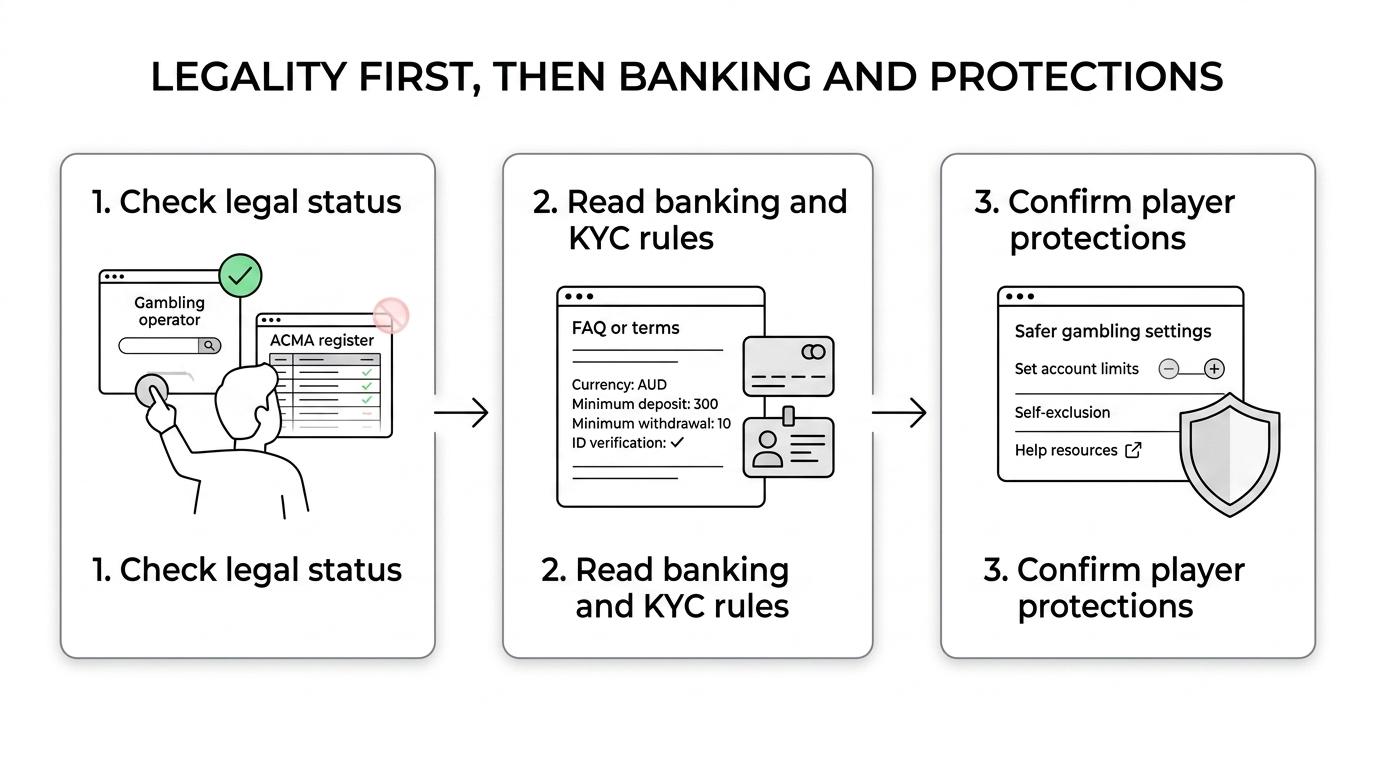 A step-by-step pre-play review flow for an Australian pokies site: legality check, money rules, protections, then game fit.
Step 1: spend the first two minutes on legality. Confirm the operator name, check ACMA guidance, and look for any sign the site is blocked, unlicensed, or vague about its status in Australia. If legality is unclear, stop there.
Step 2: spend the next two minutes on money rules. Read the FAQ or terms for currency, minimum deposit, minimum withdrawal, KYC timing, bank-name matching, and any bonus exclusion that affects cashing out. If the site cannot explain those items clearly, it has not earned a deposit.
Step 3: use the final minute on protection and game fit. Check for 18+ rules, self-exclusion options, BetStop references where relevant, help contacts, RTP visibility, and any slot-specific condition like full line bets. If the answers are easy to find, the site usually reviews better because transparency itself is a quality signal.
That routine is simple enough to repeat every time you try a new site, and strict enough to catch the issues that matter most.