How Online Pokies Australia Players Compare Volatility
Many Australians comparing online pokies start with one number: return to player (RTP). It is a sensible starting point, though it does not tell the full story. Two games can sit on a similar RTP and still feel nothing alike once the reels begin to move.
That difference usually comes back to volatility.
Volatility shapes how rewards appear across short term outcomes. One game may return smaller amounts more often. Another may hold back for long stretches, then release a larger feature win, multiplier run, or jackpot-style payout. If a player wants to compare games with any real clarity, volatility deserves the same attention as RTP, bonus features, and stake range.
It also helps to keep one basic rule in mind: pokies outcomes are random. Official guidance on poker machines makes clear that each spin is independent, so a machine is not “due” after a cold run and not “hot” in any predictive sense after a big hit.
What volatility means in online pokies Australia
Volatility is about variation, not average value. Academic guidance on electronic gaming machines describes it as the degree to which short term outcomes track the game’s programmed long-term outcomes. In plain terms, it measures how smooth or jagged the ride feels during an actual session.
A lower-volatility pokie tends to spread its value across more frequent, modest returns. A higher-volatility pokie often stores more of its value in fewer, larger rewards. Both can still arrive at a similar long-term RTP.
 Highlighted quote reading, “Volatility is not a quality rating. It is a style indicator.”
That is why volatility is not a quality rating. It is a style indicator.
- Low volatility: smaller wins landing more often
- Medium volatility: a balance of regular returns and occasional stronger features
- High volatility: longer dry spells with bigger reward potential
- Session feel: steadier balance movement at one end, sharper swings at the other
For many players, that single distinction changes everything. A person looking for longer sessions may favour a steadier reward pattern. Someone chasing larger peaks may accept a much rougher balance path to get there.
Why RTP and volatility create different session results
RTP is a long-run average, not a promise for one sitting. Regulators have repeatedly made this point about poker machines: a short session can finish well below the displayed RTP, or well above it. A full loss in a short session does not disprove the RTP, and a quick big win does not prove the game is “better” than its listed return.
This is where volatility becomes practical rather than theoretical. Imagine two pokies, both listed at 96% RTP. Game A might pay frequent wins of 0.5x to 5x stake with modest bonus rounds. Game B might pay very little for extended periods, yet hold the chance of a 100x, 500x, or larger feature. The average can be similar over a huge sample size, even though the player experience is very different.
Here is a simple comparison:
Feature | Lower-volatility pokie | Higher-volatility pokie |
|---|---|---|
Reward frequency | More frequent | Less frequent |
Typical win size | Smaller | Larger when wins land |
Balance movement | Smoother | More erratic |
Bonus round value | Usually modest | Often carries more of the game value |
Session pressure | Lower short-term swings | Higher short-term swings |
Same RTP possible? | Yes | Yes |
This is also why recent results do not predict the next spin. A random number generator decides each result independently. Volatility affects the pattern of possible outcomes across time, though it does not create momentum or memory inside the game.
How jackpots, bonus rounds and max wins shape volatility
Large jackpots and very high advertised max wins often point towards higher volatility. That does not mean every jackpot game is extreme, though it is a useful clue.
When a big share of a game’s value is concentrated in rare events, the base game usually pays more lightly. A pokie might show long stretches of small or empty returns because much of its payout design sits inside a hard-to-trigger feature, a multiplier chain, or a top-end jackpot event. In contrast, a game built around frequent line hits and modest free spins often feels calmer even when the RTP is similar.
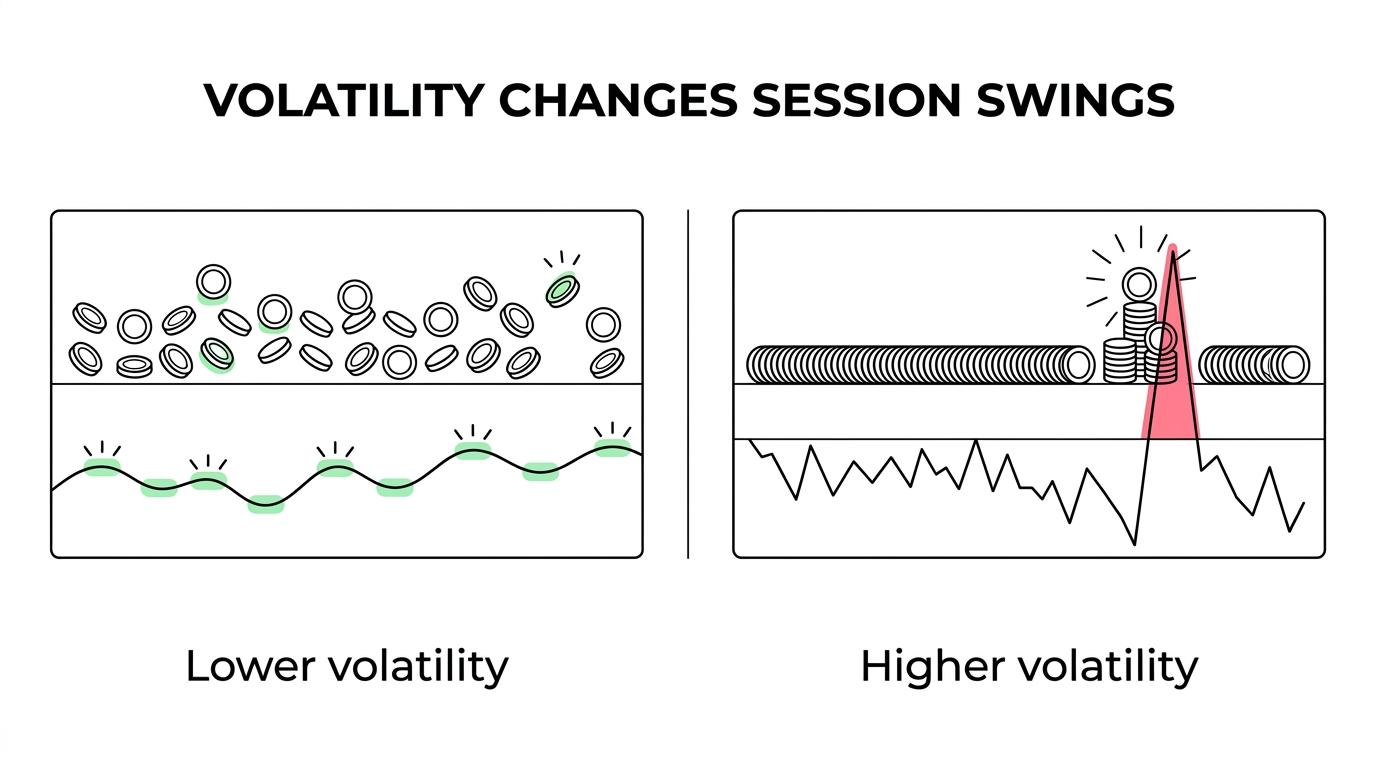 Side-by-side comparison of two online pokies with similar RTP, one showing frequent small wins and the other showing rarer larger payouts.
High excitement usually comes with a thinner stream of everyday returns.
Bonus design matters as much as the headline jackpot. If free spins, expanding wilds, pick bonuses, or re-trigger chains are responsible for most of the possible value, volatility tends to rise. If the base reels carry a healthy share of the game’s reward structure, volatility often drops into the low or medium range.
Some players also talk about a game cycle. That term can be useful as a loose description of how rewards are distributed over a very long sample, though it should not be treated as a timing tool. A short session is still only a tiny slice of that sample, and randomness can produce sharp swings far beyond what a player expects.
What Australian gambling rules mean for online pokies
Anyone researching online pokies in Australia should place legal context beside game maths. The Australian Communications and Media Authority states that the Interactive Gambling Act 2001 makes it illegal for providers to offer some online gambling services to people in Australia, including online casinos and in-play sports betting.
That means comparing RTP and volatility is only one part of the picture. Legality, licensing status, and consumer protections matter just as much. If a person is looking at a wagering service, checking official registers and regulator information is the sensible move. A polished site, a large game catalogue, or a published RTP figure does not by itself confirm that the service is lawful for Australians.
This area can change, and official regulators are the reliable reference point.
Practical ways to compare pokies volatility before play
Volatility is sometimes labelled directly on a game page, though not always. When it is not shown, players can still make a sensible comparison by reading the paytable, feature summary, and max win information together.
A high-volatility title often reveals itself through its structure. The base game may look sparse, the feature round may promise a very large multiplier range, or the top prize may be unusually high relative to stake. A lower-volatility game often spreads its value more visibly across regular symbol combinations and simpler features.
Some platforms also publish live RTP statistics or recent performance data. Those figures can be interesting, especially over large pools of play, but they do not predict the next result. They should be treated as descriptive, not predictive.
Paytable clues that signal higher pokies volatility
A quick scan of the rules page often says more than the game trailer or banner art.
- Maximum win ceiling
- Progressive jackpot link
- Rare bonus trigger wording
- Heavy multiplier features
- Sparse low-tier line wins
- Feature rounds carrying most of the game value
If several of those clues appear together, the game is probably set up for wider balance swings. That is not a flaw. It simply means the player should treat stake size and session expectations differently.
A useful habit is to compare three games side by side rather than judging one title in isolation. The differences become easier to spot when you look at reward frequency, top-end win potential, and feature weighting across multiple options at once.
Bankroll planning for low and high volatility pokies
Volatility has a direct effect on session planning. A lower-volatility game can often support longer play at a given bankroll because rewards arrive more regularly, even if many of them are modest. A higher-volatility game may require a smaller stake relative to bankroll because extended losing runs are more likely before a meaningful hit appears.
This is one reason a game can feel “tight” even when its RTP is fair on paper. If a player enters a high-volatility pokie with a stake size that is too large for the expected swings, the bankroll may not last long enough to experience the part of the distribution carrying the game’s value.
Session limit tips for pokies volatility
Good comparison is not only about reading the game. It is also about matching the game to the session.
- Set a loss limit: decide the session spend before the first spin and keep it fixed
- Match stake to volatility: the higher the volatility, the smaller the stake should usually be relative to bankroll
- Choose a time frame: lower volatility often suits longer sessions, while higher volatility asks for more patience
- Judge comfort, not hype: if long losing stretches feel frustrating, a steadier game style may be the better fit
That kind of planning turns volatility from a vague label into something useful. It helps players compare titles more honestly, read RTP figures with clearer expectations, and avoid the common mistake of treating all 96% games as if they behave the same way.
For Australians researching online pokies, that is the real value of volatility. It explains why two games with similar long-term numbers can produce very different short-term outcomes, why jackpots can change the feel of a session so dramatically, and why random spins still need disciplined expectations. When the maths, the feature design, and the legal setting are read together, game comparison becomes far sharper.